
Why Identity-First Vendor Management Is the Next Frontier in Supply Chain Security
Identity-first vendor management is the missing link between traditional third-party risk programs and real supply chain security, because every meaningful risk in a digital supply chain ultimately flows through a vendor or non-employee identity with access to your environment. Identity-first vendor management gives enterprises direct, continuous control over those identities – human and non-human – so that trust in suppliers, partners, and service providers is backed by governed access, not just contracts and questionnaires.
What is identity-first vendor management?
Identity-first vendor management is an approach that treats every vendor relationship as a governed set of identities and access rights, rather than just a contract on paper. It unifies third-party organizations, non-employee users, and machine accounts in a single, governed lifecycle that runs from onboarding through changes to timely offboarding.
Instead of relying on spreadsheets and ticket-driven processes, identity-first vendor management uses an authoritative non-employee directory, structured intake, and policy-driven automation to control who can access what, for how long, and under whose accountability. Identity becomes the system of record for vendor engagement, tying every external identity back to contract terms, project scope, risk posture, and expiration dates.
Why identity-first vendor management matters for supply chain security
Supply chain security today is inseparable from third-party access control because suppliers, partners, systems integrators, and logistics providers frequently need privileged access to applications, data, and infrastructure. When those non-employee identities fall outside HR processes and traditional governance, they become the least visible and least controlled pathways into the enterprise.
Traditional vendor risk management focuses on assessments, questionnaires, and contract clauses, but it often leaves day-to-day access decisions to scattered teams and ad hoc workflows. That gap leads to shadow vendors, orphaned accounts, over-privileged entitlements, and dormant credentials that attackers can exploit. An identity-first approach closes this gap by continuously aligning vendor access with business need, contract status, and zero-trust policies, making supply chain security measurable and enforceable at the identity layer.
Identity-first vs traditional vendor management
Traditional vendor management and identity-first vendor management share the goal of reducing third-party risk, but they differ radically in where and how control is applied. Traditional approaches govern relationships through documents, while identity-first approaches govern relationships through real-time access.
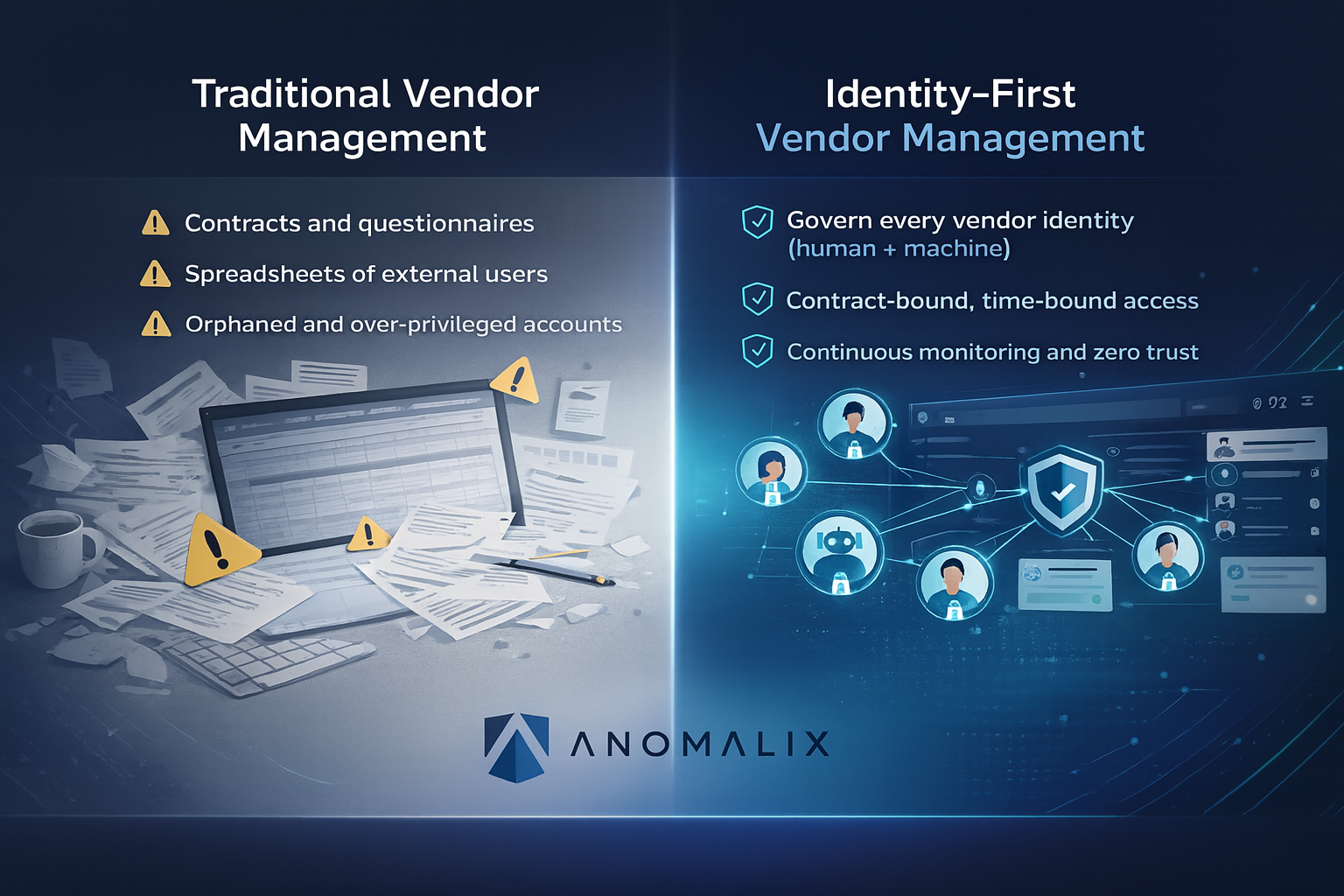
By shifting the control surface from documents to identities, identity-first vendor management transforms vendor governance from a static compliance exercise into a dynamic security practice that continuously protects the supply chain.
How identity-first vendor management works in practice
Identity-first vendor management starts with a central non-employee identity repository that brings together contractors, vendors, partners, consultants, managed service providers, and machine identities under a common model. Each identity is enriched with business-relevant metadata such as contract dates, project codes, sponsoring department, and risk level, giving teams a complete picture of who the identity is, why it exists, and how long it should exist.
On top of that repository, source-driven intake workflows ensure that vendor and non-employee data is accurate from the start. Business sponsors and procurement teams use guided forms to capture the right identity type, project scope, required applications, locations, and approvals. Once a request is approved, policy-based provisioning automatically grants least-privilege access across applications and systems according to defined rules, while setting time-bound expirations linked to contract terms.
The role of non-employee lifecycle management
Non-employees typically do not pass through HR systems, so their lifecycle is often fragmented, with unclear ownership and inconsistent updates when roles or projects change. That is why identity-first vendor management treats non-employee lifecycle management as a core pillar rather than an afterthought.
In an identity-first model, every lifecycle event – joiner, mover, extension, or leaver – is captured as a trigger that recalibrates access. When a contractor changes roles or a vendor’s scope expands or shrinks, policy-driven workflows automatically adjust entitlements, ensuring that access never drifts beyond what is justified. When a contract reaches its end date, offboarding automation closes the door completely by revoking access across all relevant systems, eliminating the most common cause of lingering supply chain risk: stale vendor accounts.
Human and non-human identities in supply chain security
Modern supply chains depend heavily on non-human identities such as APIs, service accounts, RPA bots, and integration connectors that bridge systems between organizations. These machine identities often have broad, persistent access and rarely appear in vendor management documents, yet they can be among the highest-risk accounts in the environment.
Identity-first vendor management brings human and non-human identities into a single governance plane. APIs and bots are tied to owning vendors or internal sponsors, assigned clearly scoped roles, granted time-bound or project-bound access, and monitored for anomalous behavior. This holistic view closes the blind spots where machine identities were previously created, forgotten, and left with standing privileges that attackers or misconfigurations could abuse.
How identity-first vendor management supports zero trust
Zero-trust supply chain security requires continuous verification of identities, devices, context, and behavior, rather than implicit trust in a vendor name or network location. Identity-first vendor management operationalizes zero trust for third parties by ensuring that every external identity is authenticated, authorized, monitored, and constrained according to real-time conditions and policies.
Instead of assuming that a vetted vendor is always safe, the identity-first model asks: which specific identities from that vendor are active, what are they doing right now, and does that activity still align with the contract and risk posture? Combining identity lifecycle automation with analytics allows organizations to detect dormant accounts, unusual access patterns, or policy violations and then trigger automated remediation, such as access reduction, session termination, or escalated review.
Key capabilities of an identity-first vendor management program
A mature identity-first vendor management program typically includes several foundational capabilities that together enable scalable, supply-chain-wide control:
· Central non-employee and vendor directory
A unified inventory of third-party organizations, human non-employees, and machine identities, each linked to contracts, projects, sponsors, and risk attributes, becomes the source of truth for all vendor-related access decisions.
· Structured, source-driven onboarding
Standardized onboarding processes capture complete, validated identity data and engagement context at the outset, reducing errors, preventing shadow access, and giving security and compliance teams confidence in what they see.
· Policy-based, zero-trust access controls
Role-, project-, and risk-based policies determine least-privilege access, with time-bound entitlements, conditional approvals, and mandatory multi-step sign-offs for high-risk scenarios, all enforced through automation instead of email chains.
· Closed-loop lifecycle automation
Automated provisioning and deprovisioning tied to lifecycle events and contract dates ensure that access keeps pace with real changes, eliminating the long tail of forgotten accounts and over-privileged identities.
· Continuous monitoring and audit-ready reporting
Dashboards and reports provide point-in-time and historical views of vendor access, along with anomaly detection and certification workflows that align with frameworks such as ISO 27001, ISO 31000, SOC 2, and HIPAA.
Anomalix’s identity-first point of view
Anomalix’s point of view is that vendor management, third-party risk, and identity governance cannot be handled as separate silos in a world dominated by non-employee and machine identities. Instead, they must converge on a single identity-first operating model that gives organizations end-to-end visibility and control over every external identity and the access it holds.
Through the idGenius platform and an identity-first framework, Anomalix brings together non-employee lifecycle management, third-party organization visibility, document and consent management, project-based provisioning, delegated business onboarding, and AI-guided anomaly detection. This unified approach allows enterprises to pair an identity-first vendor management layer with existing IAM and IGA systems, extending zero-trust principles deep into the supply chain without re-architecting their entire stack.
Outcomes of adopting identity-first vendor management
Organizations that adopt identity-first vendor management see concrete improvements across risk, security, efficiency, and compliance. The attack surface shrinks as dormant and over-privileged accounts are removed, while new access is tightly bound to contract terms and project scopes. Business teams gain faster, more predictable onboarding for contractors and partners, because access provisioning is automated and aligned with well-defined identity models instead of improvised per manager.
Compliance and audit readiness improve as well, because every vendor identity and entitlement can be traced back to a business need, a contract, and a set of approvals, and because point-in-time access views are readily available for regulators and assessors. Over time, the organization moves from reactive cleanup of third-party access issues to proactive, data-driven governance of vendor identities as a strategic capability.
Conclusion
From Anomalix’s perspective,identity-first vendor management is the next frontier in supply chain security,as it finally aligns risk management, security operations, and business agilityaround the source of real exposure: external identities and their associated access. As non-employee and non-human identities grow to represent the majority ofaccounts in many enterprises, only an identity-first approach can reliably keepsupply chain trust and access in sync.
By focusing vendor management on governed identities, automated lifecycle controls, and zero-trust enforcement, Anomalix helps organizations turn third-party relationships from a constant vulnerability into a controlled, measurable, and scalable strength. Identity-first vendor management is now essential for modern supply chains; it forms the foundation for how resilient, high-trust enterprises will collaborate with vendors, partners, and digital services in the future.
Contact us at info@anomalix.com to learn how our idGenius platform can help you govern your extended workforce with confidence, security, and ease.
Mohammed Elkhatib is Founder and CEO at Anomalix. Prior to founding Anomalix, Mohammed led global operations for Aveksa (acquired by RSA) where he was responsible for Sales, PreSales, Engineering and Professional Services. Mohammed is an Identity Security expert with over 25 years of IT and Business experience.