
Mastering the Non-Employee Lifecycle: Onboarding, Changes & Offboarding
In today’s interconnected business landscape, managing non-employees - contractors, vendors, consultants, partners, even machine identities—is no longer just a side concern. It’s a strategic imperative. Identity is the new cybersecurity perimeter and is the first and last line of defense. Mastering the non-employee lifecycle is critical for security, risk mitigation, efficiency, and governance.
Here’s how organizations can manage non-employee identities with precision—from the moment they onboard, through role changes, all the way to offboarding—using an identity-first, automated, zero-trust approach.
Why the Non-Employee Lifecycle Is Broken for Many Organizations
Based on Anomalix’s internal analysis and identity framework (as outlined in our strategy), enterprises face several chronic challenges when it comes to managing non-employees:
1. No Single Source of Truth
Data about non-employees or third parties often lives in fragmented systems: spreadsheets, siloed databases, emails, slack messages or disparate business units. This fragmentation creates mismatches, duplicate and outdated records, as well as security and compliance gaps.
2. Slow, Fragmented Onboarding
Onboarding non-employees is often manual, inconsistent, and highly dependent on ad hoc processes. As a result, contractors or partners may not get proper access when they need it, delaying their productivity.
3. Lack of Unified Identity Model
Because non-employees don’t flow through traditional HR systems, there's often no standard model for how they should be represented, what attributes they need, or how their contracts map to access rights. In many cases, identities are duplicate to support 1-to-many and many-to-many relationships.
4. Uncontrolled Role Changes
As non-employees shift roles, projects, or responsibilities, their identities and permission scopes may not be properly updated. This misalignment leads to over-provisioning, too much access, or security risk.
5. Offboarding Gaps
Perhaps the most dangerous issue: accounts and privileges aren’t revoked on time. Many non-employees retain access long after their engagement ends, increasing the risk of security incidents, compliance failures, and audit penalties.
Identity-First Philosophy for Non-Employees
Here’s how to architect the non-employee lifecycle in a way that is robust, automated, and secure:
Source-Driven Identity Intake
Collect standardized data from business sponsors, procurement, or department owners through tailored onboarding workflows in a single repository. That ensures the right identity type (contractor, vendor, machine) is captured with all required context.
Central Non-Employee Identity Repository
All non-employee identities live in a unified directory, complete with contract details, role, expiration dates, and ownership metadata.
Closed-Loop Automation
Lifecycle events (join, change, renewal, leave) are fully automated: once a contract starts, access is provisioned according to business rules; when a contract ends, access is revoked without delay; midsession changes trigger re-evaluation.
Zero-Trust Access Controls
Access is governed by least-privilege principles, time-bound provisioning, and continuous validation. Every access request is verified, and non-employees are treated with the same rigor as internal users.
The Lifecycle Stages, Demystified
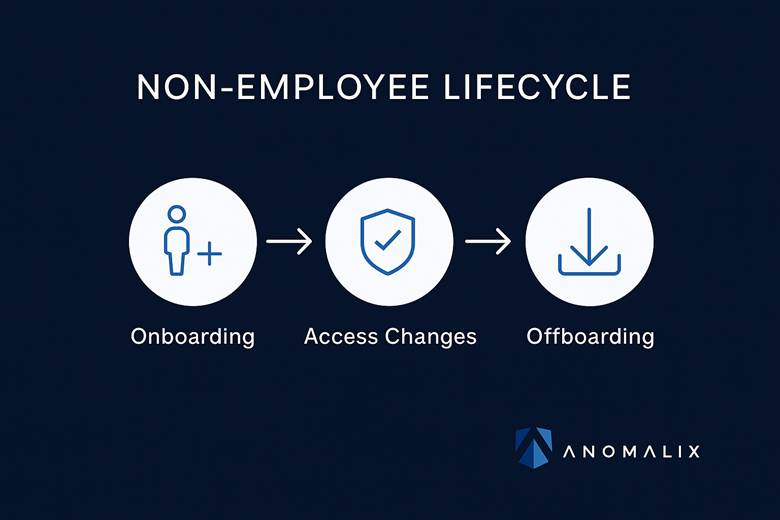
1. Onboarding: Fast, Secure & Governed
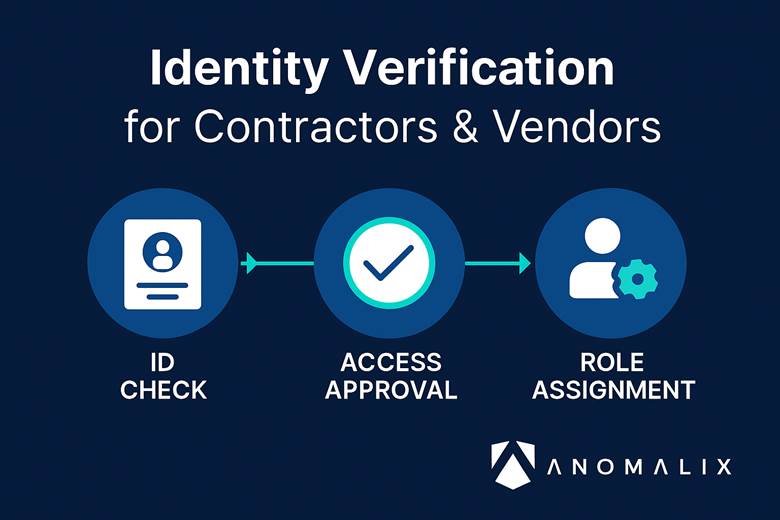
Leverage role-specific onboarding forms that collect identity type, contract dates, project scope, and required approvals. Once approved, access is provisioned automatically into IAM/IGA systems. Onboarding is structured to deliver productivity quickly without compromising security.
2. Managing Changes: Dynamic, Transparent, and Auditable
Every lifecycle change (role, project, supervisor, duration) triggers a policy-driven workflow. Closed-loop automation ensures that all access changes are evaluated, approved, and tracked. This continuous reevaluation helps prevent over-provisioning and scope creep.
3. Offboarding: Timely, Safe, Accountable
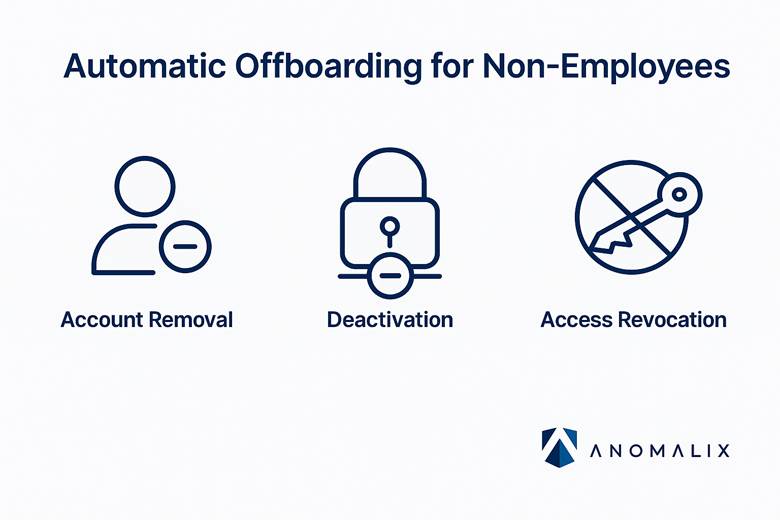
As contracts reach their end, the system issues expiry notifications. Access is automatically revoked when the engagement ends. Every action is logged for audit readiness, ensuring offboarding is not left to chance.
Deep Dive: High-Fidelity Onboarding and Secure, Automated Offboarding for Non-Employees
Onboarding and offboarding are the bookends of the non-employee lifecycle, yet they remain the most inconsistent, error-prone, and risky processes inside many organizations. When done right, they create clarity, governance, and operational efficiency. When done poorly, they create lingering security gaps, frustrated contractors, and failed audits. At Anomalix, we approach both stages with the same philosophy that guides every part of our identity-first framework: precision, automation, and accountability.
High-Fidelity Onboarding: Setting Up Non-Employees for Success
Effective onboarding is more than simply “creating an account.” It is the foundation of every identity decision that comes afterward. For non-employees, the onboarding process must bridge the gap that traditional HR workflows often leave uncovered. Contractors and vendors don’t pass through the same structured hiring steps as full-time employees, which means their identity lifecycle is more vulnerable to ambiguity.
A high-fidelity onboarding process begins with accurate, complete identity intake. Anomalix guides business sponsors through structured forms that capture contract length, engagement scope, department ownership, required access, and identity type. These data points ensure that every non-employee enters the environment with clear governance and defined accountability. Lack of this foundation is exactly why many companies struggle with over-provisioning or forgotten accounts later in the lifecycle.
Next comes automated access provisioning. Unlike manual onboarding, which varies from manager to manager, automated provisioning ties access to the engagement’s scope and the identity model defined during intake. This ensures that a contractor supporting a single project does not receive the same access as a long-term vendor partner or consultant. Every entitlement is traceable back to a defined business need.
Finally, high-fidelity onboarding includes time-bound access controls, meaning each identity is created with a natural expiration tied to contract dates. This eliminates the most common cause of orphaned accounts: forgetting to remove access after a contract ends. Onboarding is no longer a chaotic, siloed process—it becomes a controlled, repeatable, audit-ready workflow that enables fast productivity without sacrificing governance.
Secure, Automated Offboarding: Closing the Door Completely
Offboarding is where many organizations face their greatest identity risk. Non-employees often move between projects, change reporting lines, or finish engagements quietly, leaving IT teams unaware that access should be revoked. The result is a dangerous accumulation of dormant accounts that attackers can easily exploit.
Anomalix tackles offboarding with closed-loop automation that triggers the moment a contract reaches its end date. Instead of relying on managers to remember offboarding steps—or vendors to notify the business—identity expiration is governed by system logic. This dramatically reduces the window of exposure where non-employees retain access longer than necessary.
But automated removal is only part of the equation. True secure offboarding also includes revocation of access across all systems, not just primary accounts. Shared drives, collaboration tools, network zones, VPN credentials, SaaS applications—all are systematically deprovisioned, eliminating shadow access or forgotten entitlements. Every action is logged, creating an audit-friendly trail that proves compliance with internal policies and external regulations.
Additionally, secure offboarding ensures no lateral movement occurs after the engagement ends. In environments that follow zero-trust principles, offboarding must be immediate, comprehensive, and verifiable. Through automated deactivation, expiration alerts, and evidence generation, Anomalix transforms offboarding from a risky, inconsistent task into a fully governed identity event.
Common Risks in Non-Employee Identity Management — and How to Avoid Them
Despite their critical role in the extended workforce, non-employees often operate within the least governed identity pathways inside an organization—creating blind spots that attackers or internal errors can easily exploit. The most common risks include:
1. Over-Provisioned Access
Non-employees frequently receive more access than needed, either due to unclear role definitions or manual provisioning. This unnecessarily expands the attack surface and increases the chance of data exposure.
How to mitigate it:
Least-privilege policies, automated role-based provisioning, and ongoing access recalibration through life-event triggers.
2. Orphaned or Dormant Accounts
When contracts end but accounts stay active, they become an open door for unauthorized access.
Best Practice Consideration:
Contract-bound identities and automated offboarding ensure accounts are deactivated the moment engagement ends.
3. Unverified or Incomplete Identity Data
Incomplete onboarding data—such as missing sponsors, inaccurate contract dates, or undefined scopes—leads to chaotic governance and audit failures.
How to fix it:
Source-driven intake forms, strict validation rules, and business-owner accountability.
4. Shadow Access Through Informal Processes
Many teams bypass identity processes to “get things done quickly,” resulting in unmanaged entitlements.
This can be prevented by offering simple, guided business workflows that eliminate multiple “front doors”. By enforcing a single source of truth and enabling business users to perform requests and approval through a common platform, the business is driving security and compliance without requiring technical expertise.
5. Vendor and Partner Ecosystem Risk
If a third-party organization suffers a breach, attacker access often cascades into the enterprise. This risk can be minimized through time-bound access, continuous verification, and zero-trust guardrails that limit lateral movement. By addressing these risks with identity-first governance and closed-loop automation, organizations can turn the non-employee lifecycle from a liability into a fully governed, secure, and auditable process.
Why This Matters — The Real-World Impact
By mastering the non-employee lifecycle using Anomalix’s identity-first, automated approach, organizations can:
Reduce risk by closing orphaned or overprivileged accounts.
Improve efficiency — contractors and partners become productive faster, without manual delays.
Strengthen compliance through audit-ready workflows and thorough access reviews.
Scale securely — as the non-employee population grows, governance remains consistent and controlled.
Support zero-trust — every non-employee identity is treated under the same strict access model as internal staff.
Why Companies Choose Anomalix
Because we deliver:
A unified platform tailored for non-employee identity governance.
Standardized onboarding forms that capture business-relevant data.
Automated lifecycle management, from joiner to leaver.
Delegated governance, letting business owners (or vendor liaisons) own the process with oversight.
Continuous visibility & auditability — monitoring, reviews, and reporting built in.
Zero-trust enforcement: context-aware access, just-in-time privileges, and strict verification.
Conclusion
The non-employee lifecycle isn’t a secondary concern — it’s a central pillar of secure, modern identity governance. At Anomalix, we believe that governing external identities with the same rigor as your internal workforce is non-negotiable. Through identity-first modeling, closed-loop automation, and zero-trust controls, organizations can dramatically reduce risk, scale their extended workforce, and stay audit-ready.
Ready to take control of your non-employee identity program?
Contact us at info@anomalix.com to learn how our idGenius platform can help you govern your extended workforce with confidence, security, and ease.
Mohammed Elkhatib is Founder and CEO at Anomalix. Prior to founding Anomalix, Mohammed led global operations for Aveksa (acquired by RSA) where he was responsible for Sales, PreSales, Engineering and Professional Services. Mohammed is an Identity Security expert with over 25 years of IT and Business experience.