
Identity-First Vendor Management: Modernizing How Enterprises Govern Third-Party Access
Why Vendor Identity Has Become a Strategic Risk Surface
Enterprises today operate within deeply interconnected ecosystems. Vendors, suppliers, service partners, contractors, temporary staff, and outsourced teams now play critical roles across operations, production, digital transformation, and customer delivery. While these external relationships unlock capacity and expertise, they also introduce an increasingly complex layer of risk—one that traditional procurement-centric vendor management frameworks were never designed to govern.
Historically, organizations have evaluated vendor exposure through contractual terms, financial posture, data safeguards, and compliance checklists. But as digital ecosystems expand, identity—not contracts—has become the true foundation of trust and risk. Every external relationship ultimately materializes as one or more identities gaining access to enterprise systems, data, and workflows. Those identities—human or machine—can be misconfigured, over-privileged, orphaned, or exploited long before a contract even expires.
This gap between contractual oversight and identity-centric governance is the blind spot that today’s attackers increasingly target. High-profile cyber incidents over the past decade consistently trace back to third-party access: unmanaged accounts, stale credentials, excessive permissions, or uncontrolled remote connections. The reality is unavoidable: as enterprises scale their vendor ecosystems, they unintentionally widen the aperture for identity-related exposure.
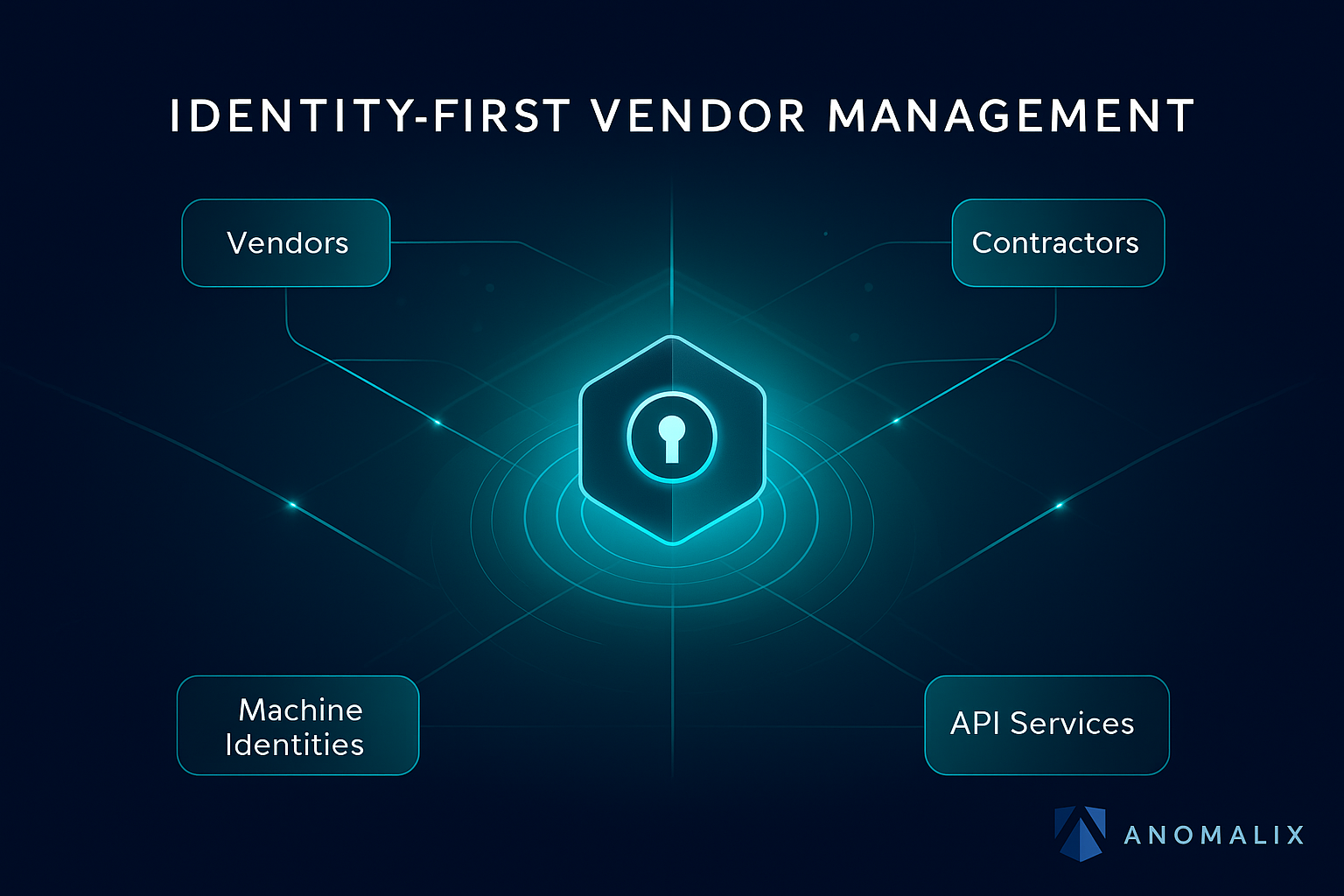
Identity-First Vendor Management redefines how organizations govern third parties by placing identity—not paperwork—at the center of oversight. This model ensures that every vendor identity is verified, governed, monitored, and deprovisioned with the same rigor applied to a full-time employee. It turns vendor governance into an active, operational practice rather than a passive checkpoint.
The following sections explore how this shift is reshaping modern enterprise security, and why organizations that embrace identity-first thinking are building stronger, more resilient ecosystems.
The Expanding Vendor Ecosystem and the Architectural Identity Gap
Most enterprises now operate with hundreds—or thousands—of active vendors at any given time. Each vendor represents far more than a contractual entity; it represents a fluid ecosystem of contributors whose roles, access needs, and responsibilities continuously change. Cloud adoption, outsourcing, managed services, globalized supply chains, and SaaS models have amplified this complexity.
Yet surprisingly few organizations can answer fundamental operational questions, such as:
- Who within each vendor has access to enterprise systems?
- What identities—human or machine—belong to each vendor?
- Which permissions do these identities hold today?
- How many of them remain active long after they should be removed?
- Who inside the enterprise is responsible for each vendor identity?
This uncertainty is the architectural identity gap. Vendor management systems collect documents. IT systems create accounts. Security teams monitor activity. But no unified mechanism binds the vendor, their users, and their access lifecycles into a coherent governance framework. As a result:
- Orphaned vendor accounts accumulate unnoticed
- Privileged vendor access grows unchecked
- Accounts outlive contracts and project timelines
- Machine identities proliferate without governance
- Security teams lack visibility into third-party identity behaviors
Identity-First Vendor Management eliminates this gap by treating each vendor identity as a first-class entity within enterprise governance—tracked, justified, monitored, and removed automatically.
Why Traditional Vendor Management Cannot Address Modern Security Demands
Procurement-led vendor management frameworks were built for evaluating business relationships, not overseeing access. Although due diligence, questionnaires, and compliance attestations remain necessary, they do not mitigate identity risk.
This mismatch creates three foundational challenges:
a. Lifecycle Misalignment
Vendor onboarding often triggers manual identity requests via tickets and emails. Offboarding depends on someone remembering to submit a removal request. Contracts end, but accounts remain active. Roles change, but permissions do not. This creates long-term residual access that attackers exploit.
b. Fragmented Ownership and Visibility
Vendor access involves multiple teams:
- Procurement manages contracts
- IT creates accounts
- Security monitors access
- Business units sponsor vendors
But no single authority governs identity truth across all stages. Without unified visibility, organizations cannot ensure the right people have the right access at the right time.
c. Incomplete Compliance and Audit Evidence
Modern audits increasingly demand identity-level proof for vendors:
- Who approved access?
- When was access modified?
- What was the business justification?
- When was access removed?
- What activity occurred during access?
Traditional systems simply cannot answer these questions without significant manual effort.
Identity-first vendor governance replaces fragmented oversight with continuous, automated identity lifecycle control—ensuring every access decision is visible, justified, and auditable.
Identity-First Vendor Management: A New Governance Model for Modern Enterprises
Identity-First Vendor Management reframes vendor oversight around the individuals and machine accounts that actually interact with enterprise systems. Rather than managing vendors as organizational abstractions, this approach governs:
- Vendor employees
- Short-term contractors
- Remote specialists
- Managed service teams
- Temporary staff
- Machine identities and service accounts
- Artificial Intelligence (AI) Agents
- Automated workflows and bots
- External developers and integrators
Each identity receives the same level of scrutiny applied to internal users. Identity-first governance introduces a unified operational standard:
- Identities are validated, verified, and proofed
- Access is tied to real business justifications
- Permissions adjust as roles and responsibilities evolve
- Accounts are monitored continuously
- Deprovisioning happens automatically when access is no longer needed
This creates a dynamic, real-time governance model that reflects how modern ecosystems actually function.
The Core Pillars of Identity-First Vendor Governance
a. Rigorous Identity Proofing and Verification
Before any vendor user accesses enterprise systems, their identity must be validated. This includes:
- Confirming their association with the vendor
- Verifying identity documentation
- Assigning them to a responsible internal sponsor
- Establishing role and purpose clarity
Identity assurance blocks unauthorized and impersonated access before it begins.
b. Automated Identity Lifecycle Management
Automation replaces manual ticket-driven processes. Access is granted, adjusted, or revoked automatically based on:
- Contract timelines
- Project milestones
- Role updates
- Completion of required certifications
- Policy changes
- Security signals
No identity persists longer than justified.
c. Continuous, Contextual Access Governance
Static permissions no longer suffice. Identity-first systems use dynamic controls informed by:
- User behavior
- Location and device posture
- Access frequency and patterns
- Privilege escalation attempts
- Real-time risk scoring
This ensures permissions adapt to real-world conditions.
d. Unified Visibility Across All Vendor Identities
A centralized identity governance layer allows organizations to view:
- Every vendor identity
- Every permission each identity holds
- How access was approved
- When it is set to expire
- All historical activity
Visibility drives intelligence, and intelligence drives governance.
Extending Zero Trust to Vendor Ecosystems
Zero Trust has become a foundational security philosophy—but its principles are often applied only to internal users. Vendor ecosystems typically operate on implicit trust: once the vendor is approved, their employees receive broad, persistent access.
Identity-first vendor governance extends Zero Trust across all external identities by enforcing:
- Never trust a vendor identity by default
- Continuously verify identity and behavior
- Enforce least-privilege and just-in-time permissions
- Monitor access activity in real time
- Automatically remediate anomalies
This brings third-party access under the same security discipline applied internally—ensuring external contributors do not inadvertently undermine Zero Trust strategies.
Operationalizing Identity-First Vendor Governance at Enterprise Scale
Implementing identity-first governance does not require replacing existing systems. Instead, organizations can build on current workflows while adding identity-centric oversight. Key steps include:
- Inventory all vendor identities and accounts
- Link identity lifecycles to contract workflows
- Establish internal sponsorship and ownership rules
- Adopt identity proofing and verification protocols
- Automate access provisioning and certification cycles
- Apply policy-based and attribute-driven access controls
- Monitor activity continuously and respond to anomalies
These steps create a cohesive governance model that is both scalable and operationally efficient.
The Role of Machine Identities in Vendor Relationships
As automation accelerates, machine identities—APIs, service accounts, bots, integration connectors—play a growing role in vendor operations. Unlike human users, machine identities:
- Do not expire
- Are rarely rotated
- Often hold high privilege
- Are frequently overlooked in audits
- Are susceptible to credential theft
Identity-first vendor governance ensures machine identities follow the same lifecycle controls as human users:
- Defined ownership
- Verified purpose
- Permission rationalization
- Continuous monitoring
- Automated deprovisioning
This prevents machine access from becoming an unmanaged backdoor.
Looking Ahead: AI, Automation, and the Future of Vendor Governance
The next decade will bring larger ecosystems, more automation, and deeper third-party integration across critical operations. Identity-first governance provides the foundation for this future by enabling:
- AI-driven identity risk detection
- Automated privilege adjustments
- Continuous compliance evidence generation
- Behavior-aware authentication
- Unified governance across human and machine identities
As external ecosystems grow, identity becomes the most reliable and precise method for managing risk. Enterprises that master identity-first governance will operate with greater confidence, agility, and resilience.
The Anomalix Perspective: Why Identity-First Vendor Governance Is No Longer Optional
At Anomalix, we view vendor identity governance not as a security enhancement, but as a strategic necessity. Modern enterprises operate across distributed digital ecosystems where trust must be earned, verified, and continuously reinforced—not assumed. The traditional distinction between “internal” and “external” users is dissolving, and the velocity of collaboration with third parties has exceeded the capacity of manual processes and disconnected oversight models.
From our perspective, vendor risk is fundamentally identity risk. The identities that vendors bring—whether human operators, automated scripts, API-driven service accounts, or sophisticated machine-to-machine integrations—interact with critical systems in ways that bypass older governance boundaries. These identities require the same rigor, visibility, and lifecycle control that internal workforce identities receive, but at a scale and velocity that demand automation, intelligence, and continuous assurance.
We believe that organizations must shift away from contract-driven vendor oversight and adopt identity-first operational frameworks that are proactive rather than reactive. This means unifying identity proofing, policy enforcement, behavioral monitoring, privilege management, and automated deprovisioning inside a single governance fabric that spans the entire vendor ecosystem.
Anomalix also recognizes that machine identities will increasingly outnumber human identities—and with that shift, the attack surface will evolve. Machine-to-machine communication, API access, integration workflows, and automated vendor services will require identity-first controls that extend Zero Trust to every digital entity interacting with enterprise systems.
Our perspective is clear: Identity-First Vendor Management is not just a modernization of traditional vendor governance; it is the architectural foundation for resilient, scalable digital ecosystems. Organizations that adopt this model secure their operations, strengthen compliance, and reduce vendor-related uncertainty—positioning themselves to thrive in an environment defined by constant change, interconnected systems, and expanding external dependencies.
Conclusion: Identity as the Foundation of Vendor Trust
Vendor relationships are essential to modern operations, but they also create systemic risks that cannot be addressed through contracts or questionnaires alone. Identity has emerged as the most accurate and governable lens through which organizations can evaluate and control third-party exposure.
Identity-First Vendor Management strengthens governance by transforming vendor oversight into a dynamic, automated, and intelligence-driven practice. By unifying identity assurance, lifecycle automation, continuous monitoring, and Zero Trust controls, organizations gain the clarity and operational discipline they need to secure their extended ecosystems.
To explore how Anomalix can help your organization strengthen identity governance and secure your extended ecosystem, contact us at info@anomalix.com.
Mohammed Elkhatib is Founder and CEO at Anomalix. Prior to founding Anomalix, Mohammed led global operations for Aveksa (acquired by RSA) where he was responsible for Sales, PreSales, Engineering and Professional Services. Mohammed is an Identity Security expert with over 25 years of IT and Business experience.