
How to meet PCI, DSS and NIST CFE requirements for Third-Party and Non-Employee Identities
In today’s interconnected digital economy, organizations don’t just manage employees—they manage ecosystems: contractors, partners, suppliers, vendors, and an ever-expanding inventory of machine identities such as APIs, bots, and service accounts. These external and non-human identities are central to business operations, yet too often they sit beyond the reach of traditional identity controls and compliance programs.
At Anomalix, we believe identity is the fulcrum of modern cybersecurity. When identities lack robust governance—especially those outside HR systems—it creates invisible risk. This is true not just for security posture, but also for compliance with critical frameworks like PCI DSS and the NIST Cybersecurity Framework (CSF).
In this article, we explore why aligning non-employee identity governance with PCI DSS and NIST CSF is more than a best practice—it’s a strategic necessity for meeting regulatory requirements, reducing risk, and building confidence across your extended workforce.

Understanding the Compliance Landscape
What is PCI DSS?
The Payment Card Industry Data Security Standard (PCI DSS) is a globally recognized set of security requirements designed to protect cardholder data. It applies to any organization that stores, processes, or transmits payment card information and mandates specific controls such as network segmentation, strong access controls, encryption, and regular monitoring. PCI DSS is not optional for covered entities—it’s required to continue accepting payment card transactions.
PCI DSS is highly prescriptive. Its 12 core requirements are specific and detailed, leaving little ambiguity about what must be done. However, that prescriptive nature also means the requirements were built with traditional system users in mind—largely employees and internal services—not the complex lifecycle patterns of external identities.
What is the NIST Cybersecurity Framework (CSF)?
In contrast, the NIST CSF is a voluntary framework developed by the U.S. National Institute of Standards and Technology. Rather than a checklist, NIST CSF is a flexible, risk-based model composed of the functions Identify, Protect, Detect, Respond, and Recover. It’s designed to give organizations of all sizes a common language and structure for building and continuous improvement of cybersecurity programs.
While PCI DSS focuses on protecting payment data, NIST CSF emphasizes holistic risk management. Organizations adopting NIST CSF tailor controls based on their risk profiles and business priorities.
The Intersection of PCI DSS and NIST CSF
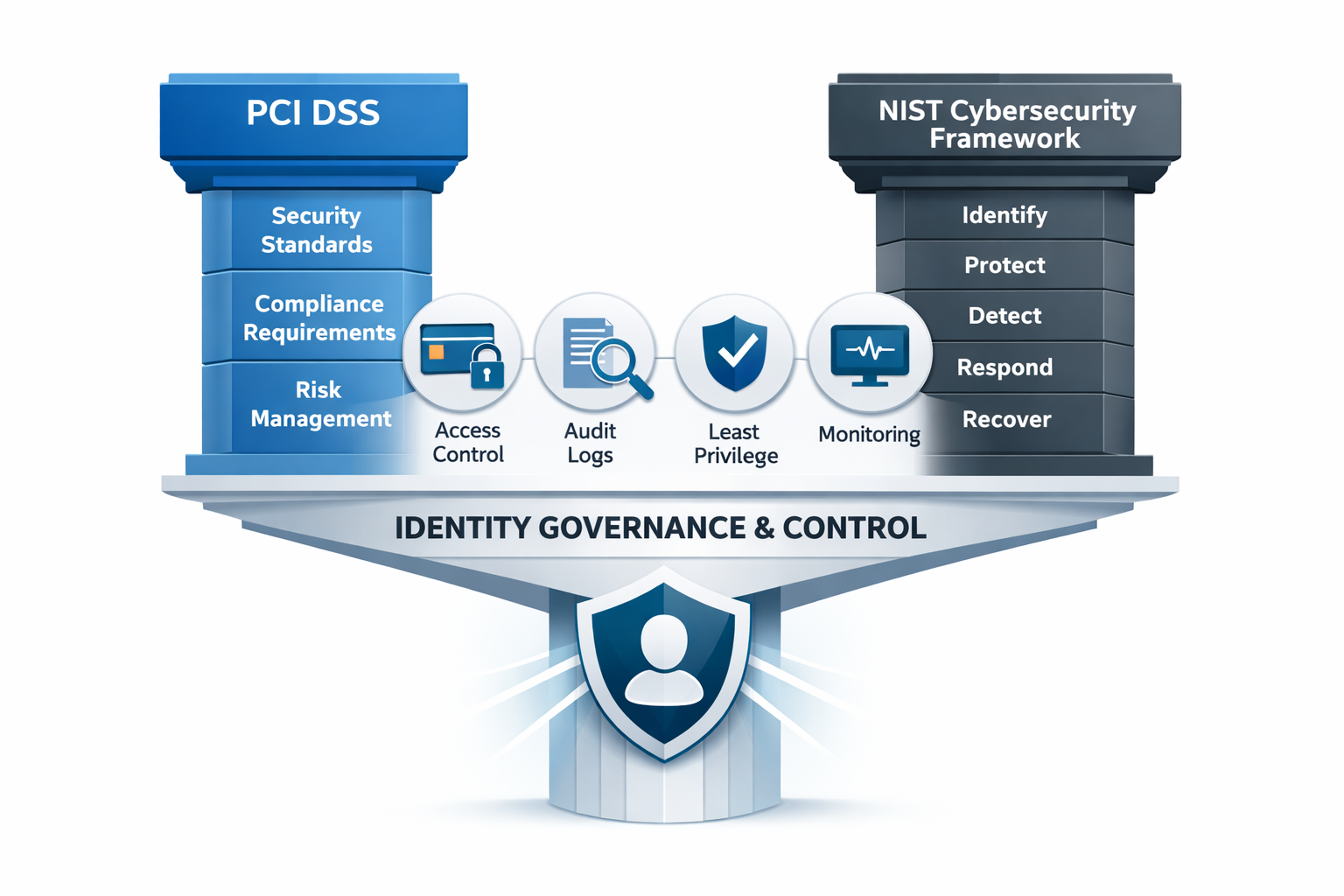
Though different in structure and intent, PCI DSS and NIST CSF share common goals: protecting sensitive data, managing risk, and assuring stakeholders of ongoing security. In fact, PCI DSS requirements have been mapped to NIST CSF subcategories to help organizations align compliance and risk management efforts efficiently.
Yet this mapping also highlights why frameworks alone aren’t enough: neither PCI DSS nor NIST CSF explicitly addresses governance for non-employee identities. That’s a governance gap many organizations are discovering at audit time or, worse, in the wake of a breach.
Non-Employee Identities: The Governance Blind Spot
External identities don’t behave like internal ones. They:
- Enter and leave systems based on contracts, projects, or external timelines
- Operate across divisions, platforms, and service boundaries
- May lack centralized oversight or documented ownership
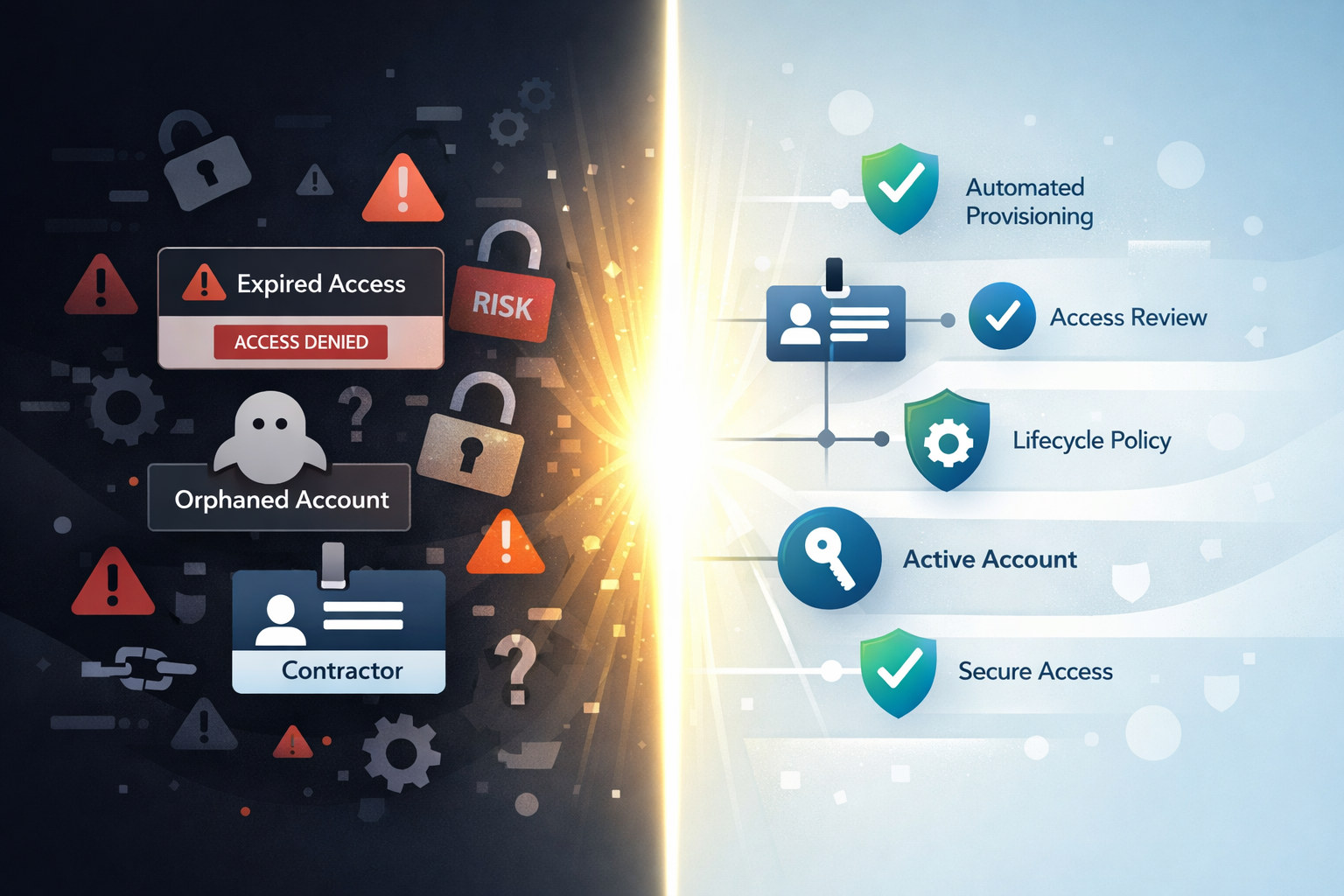
These characteristics make them prone to excessive access, orphaned accounts, and untracked credentials—exactly the conditions that enable breaches and compliance failures.
Yet traditional IAM/IGA tools are designed for employees and assume HR systems as the source of truth. For non-employees, the identity lifecycle is often scattered across procurement tools, contracts, tickets, and spreadsheets, with no unified control plane.
This governance gap isn’t just a theoretical risk—it undermines compliance objectives too. For PCI DSS, uncontrolled external access threatens key requirements like restricting access to cardholder data and maintaining audit trails. For NIST CSF, it weakens risk management outcomes in Protect and Detect functions, where identity control is foundational.
The Cost of Getting Non-Employee Identity Governance Wrong
When organizations think about compliance failures, they often focus on missed controls, outdated policies, or technical misconfigurations. But in reality, some of the most expensive and damaging compliance gaps stem from unmanaged non-employee identities.
Contractors with lingering access after a project ends, vendors with overly broad permissions, or service accounts with hard-coded credentials can quietly undermine both PCI DSS and NIST CSF alignment. These identities often operate under the radar, yet they can access the same sensitive systems and data as full-time employees. When an audit or incident occurs, organizations struggle to answer basic questions: Who owns this account? Why does it exist? What data can it access?
From a PCI DSS perspective, this lack of accountability directly conflicts with requirements around least privilege, access restriction, and auditability. Auditors expect organizations to demonstrate tight control over all identities that can touch cardholder data—not just those managed by HR. Similarly, under the NIST CSF, unmanaged non-employee identities weaken the Identify and Protect functions, increasing overall cyber risk and reducing an organization’s ability to detect or respond effectively.
Beyond compliance, the operational cost is significant. Manual access reviews consume time, security teams chase down account owners, and business leaders face delays when onboarding new partners. Worse still, breaches involving third-party or contractor access often lead to reputational damage, regulatory scrutiny, and loss of customer trust.
At Anomalix, we see these challenges not as isolated issues, but as symptoms of fragmented identity governance. Solving them requires visibility, automation, and accountability built specifically for non-employee identities—before auditors or attackers expose the gaps.
Why Meeting PCI DSS and NIST CSF Requires Better Identity Governance
1. Access Control Must Be Comprehensive and Contextual
Both PCI DSS and NIST CSF emphasize access management. PCI DSS requires unique IDs for access and authentication controls, while NIST CSF’s Protect function calls for identity verification and least-privilege principles.
Non-employee identities often bypass these controls. Without granular visibility into who they are, why they’re accessing systems, and for how long, organizations can’t reliably prove compliance with access restrictions or enforce least privilege—a fundamental requirement for both frameworks.
2. Audit Trails Need Complete and Accurate Records
PCI DSS mandates logging and monitoring of all access to cardholder data and the ability to associate actions with unique identities. NIST CSF extends this with continuous monitoring and logging under its Detect function.
If contractors or machine identities are accessing systems without centralized identity governance, audit logs become fragmented and incomplete. This not only complicates compliance reporting but can make auditors question the integrity of your entire control environment.
3. Lifecycle Management Must Be Automated, Not Manual
Non-employee identities often change status—new contracts start, terms end, roles evolve. PCI DSS and NIST CSF alike expect organizations to respond to changes in access needs quickly and consistently.
Manual deprovisioning and ticket-based access changes are slow, error-prone, and unsustainable at scale. A solution that automates user lifecycle actions—especially expirations and access reviews—is critical to maintaining compliance over time.
Practical Steps to Bridge Governance and Compliance
Meeting compliance requirements for external identities isn’t just about checking boxes—it’s about operationalizing identity governance in ways that support both frameworks.
Here’s how modern organizations should approach it:
1. Establish Centralized Identity Visibility
You can’t manage what you can’t see. Start by creating a central repository of all identities—employees, contractors, vendors, and machines. Understand who they are, what they access, why they have access, and how long it should persist.
This perspective is essential for both PCI DSS audit readiness and NIST CSF risk assessment.
2. Enforce Policy-Driven, Role-Based Access
Define access policies that reflect business needs and compliance requirements. Use role-based access controls (RBAC) with fine-grained permissions tailored to non-employee roles and risk profiles. Ensure access is time-bound and tied to valid use cases.
This not only satisfies access control mandates but also supports NIST CSF’s risk-based prioritization.
3. Automate Lifecycle Events
Automated onboarding, access modification, and offboarding are critical. These workflow automations ensure accurate, timely changes to access, reducing orphaned accounts and stale credentials that could violate PCI DSS logging and NIST CSF protection goals.
4. Maintain Continuous Monitoring and Reporting
Continuous monitoring and real-time reporting bring compliance and security together. Track identity status changes, access patterns, and anomalous behaviors. Generate compliance reports that demonstrate the effectiveness of your controls to auditors and stakeholders.
How Anomalix Approaches Identity Governance and Compliance
At Anomalix, we’ve built idGenius to meet precisely these challenges.
Non-employee identities are not an afterthought—we treat them as a first-class security problem that demands purpose-built governance. idGenius provides:
- Centralized identity lifecycle management for contractors, partners, vendors, and machine identities
- Automated policy enforcement and access reviews that align with compliance requirements
- Real-time visibility into who has access, why they have it, and when it should be revoked
- Audit-ready trails and compliance reporting that support PCI DSS and NIST CSF objectives
By aligning governance with compliance, idGenius helps organizations stay secure and audit-ready without manual toil.
Conclusion: Governance Is the Compliance Foundation
Meeting PCI DSS and NIST CSF requirements is not a one-time project—it’s an ongoing commitment to visibility, control, and continuous improvement. When governance extends beyond employees to every identity in your extended digital ecosystem, you not only strengthen your security posture but also make compliance a natural outcome of your operations.
Non-employee identities must be governed with the same precision as internal ones. Identity governance is no longer optional—it’s foundational to robust cybersecurity and compliance.
Contact us at info@anomalix.com to learn how our idGenius platform can help you govern your extended workforce with confidence, security, and ease.
Mohammed Elkhatib is Founder and CEO at Anomalix. Prior to founding Anomalix, Mohammed led global operations for Aveksa (acquired by RSA) where he was responsible for Sales, PreSales, Engineering and Professional Services. Mohammed is an Identity Security expert with over 25 years of IT and Business experience.