
Blog
How to Enforce Least Privilege for Vendors and Contractors
Mohammed Elkhatib
Mohammed Elkhatib is Founder and CEO at Anomalix. Prior to founding Anomalix, Mohammed led global operations for Aveksa (acquired by RSA) where he was responsible for Sales, PreSales, Engineering and Professional Services. Mohammed is an Identity Security expert with over 25 years of IT and Business experience.

Introduction: The Hidden Risk in Your Extended Workforce
Modern enterprises no longer operate within clearly defined organizational boundaries. Digital transformation, cloud adoption, and the rise of remote work have dramatically expanded who needs access to corporate systems—and how quickly that access must be granted. Vendors, contractors, consultants, service providers, and temporary workers are now embedded deeply into daily operations.
While this extended workforce model accelerates innovation and reduces costs, it also introduces one of the most underestimated security risks today: over-privileged non-employees.
At Anomalix, we consistently see organizations invest heavily in protecting employee identities while leaving vendor and contractor access loosely governed, manually managed, or—worse—forgotten entirely. The result? Dormant accounts, excessive entitlements, audit failures, and a significantly larger attack surface.
The principle of least privilege—granting only the access required to perform a specific task for a specific period—has long been a cornerstone of cybersecurity. Yet enforcing least privilege for vendors and contractors is far more complex than it sounds.
In this blog, we’ll explore why enforcing least privilege for third parties is so difficult, the risks of getting it wrong, and—most importantly—how organizations can implement a scalable, auditable, and automated approach to governing vendor and contractor access.
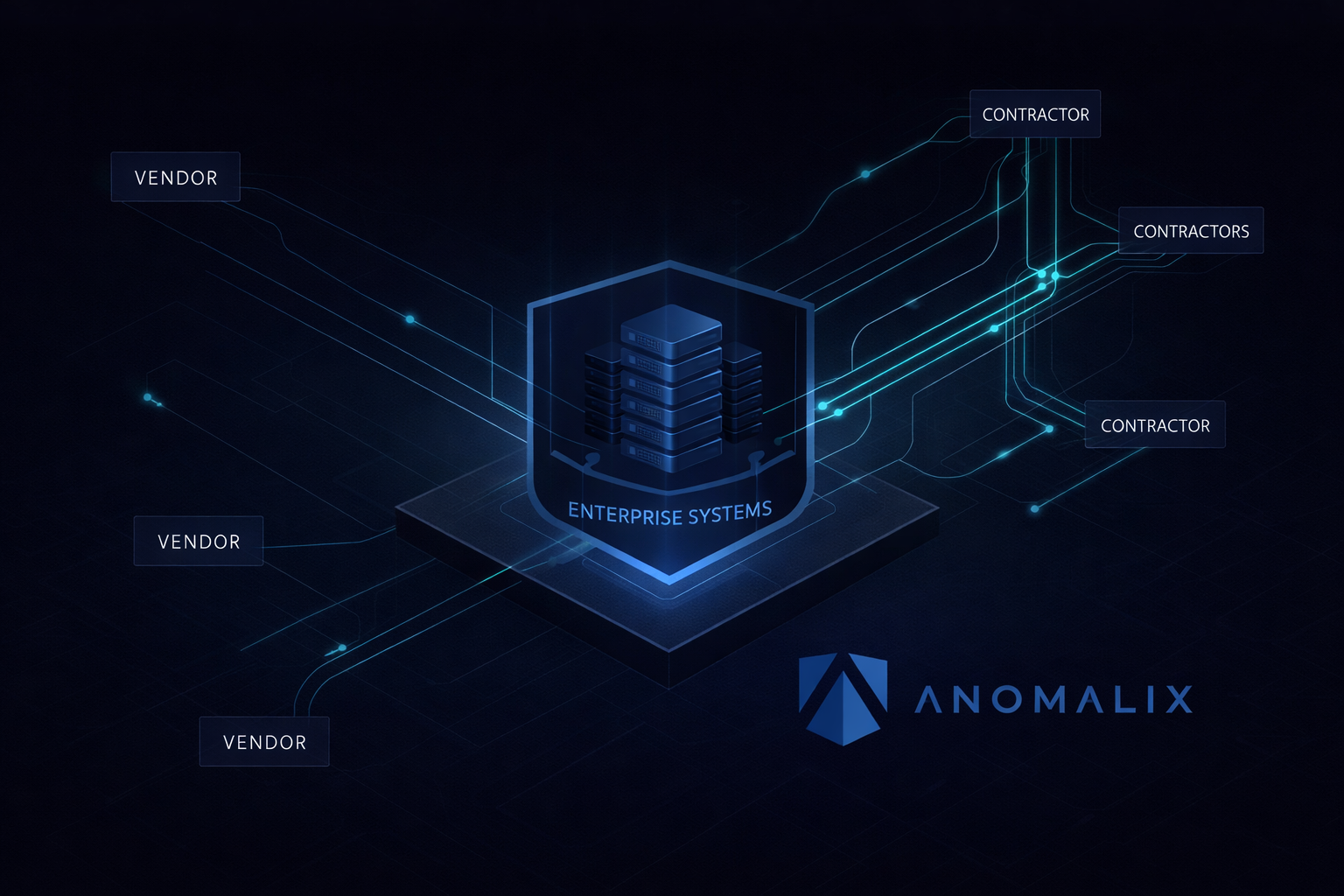
Why Vendors and Contractors Pose a Unique Access Risk
Unlike full-time employees, vendors and contractors exist outside traditional HR lifecycles. They often:
- Join and leave on irregular timelines
- Work across multiple departments or projects
- Require elevated or sensitive access
- Are sponsored by business users, not HR
- Fall outside centralized identity processes
From an identity governance perspective, this creates a perfect storm.
1. No Clear Ownership of Access
Who is responsible for approving, reviewing, and revoking a contractor’s access?
- HR?
- IT?
- Procurement?
- The business sponsor?
In many organizations, the answer is “everyone and no one.” Without clear ownership, access decisions become inconsistent, undocumented, and difficult to audit.
2. Access Outlives the Engagement
One of the most common findings in security assessments is vendor access that persists long after a contract ends. Accounts are rarely deprovisioned on time because:
- End dates were never captured
- Extensions were informal
- Sponsors changed roles or left
- Manual processes failed
Each lingering account represents an open door into your environment.
3. Excessive Privileges Accumulate Over Time
Vendors often start with limited access but gradually accumulate more permissions as projects evolve. Without regular reviews, this leads to privilege creep—where third parties end up with access far beyond their original scope.
This violates least privilege and dramatically increases breach impact.

Understanding Least Privilege in the Context of Third Parties
Least privilege is not about restricting productivity. It’s about precision, accountability, and control.
For vendors and contractors, least privilege means:
- Access is tied to a specific role or task
- Access is granted for a defined time window
- Privileges are reviewed regularly
- Access is automatically revoked when no longer needed
Achieving this requires moving beyond ad-hoc approvals and spreadsheets.
Common Mistakes Organizations Make
Before discussing best practices, it’s important to recognize where organizations typically go wrong.
Mistake #1: Treating Vendors Like Employees
Many companies onboard contractors using employee identity workflows. This often leads to:
- Overly broad access
- No contractual alignment with access duration
- Lack of sponsor accountability
Third parties require distinct identity models.
Mistake #2: Relying on Manual Processes
Email approvals, shared spreadsheets, and ticket-based access requests do not scale. Manual processes are:
- Error-prone
- Difficult to audit
- Slow to adapt to change
Least privilege enforcement cannot succeed without automation.
Mistake #3: One-Time Access Reviews
Annual or biannual access reviews are insufficient for vendors whose roles change frequently. Least privilege requires continuous governance, not periodic check-ins.
Building a Least Privilege Framework for Vendors and Contractors
At Anomalix, we believe effective least privilege enforcement rests on five foundational pillars.
1. Establish Clear Vendor Identity Ownership
Every non-employee identity must have a business sponsor.
This sponsor is accountable for:
- Requesting access
- Justifying access levels
- Certifying access regularly
- Confirming engagement end dates
Without a sponsor, access should not exist.
Best practice:
- Enforce mandatory sponsor assignment for all vendor identities
- Automatically disable access when sponsorship lapses
2. Define Role-Based Access for Vendors
Least privilege cannot be implemented on an ad-hoc basis. You need predefined access profiles.
Instead of granting access system by system, define:
- Vendor roles aligned to job functions
- Application-specific entitlements per role
- Data sensitivity boundaries
For example:
- “External Network Engineer”
- “Third-Party Finance Analyst”
- “Temporary Customer Support Agent”
Each role should be carefully scoped and approved by security and business stakeholders.
3. Enforce Time-Bound Access by Default
Vendor access should never be indefinite.
Every access request should include:
- A start date
- An end date
- Automatic expiration
Time-bound access ensures that privileges naturally expire—even if someone forgets.
This single control dramatically reduces orphaned accounts.
4. Automate Access Reviews and Certifications
Manual reviews are unsustainable. Automated certifications ensure:
- Regular validation of access
- Clear audit trails
- Sponsor accountability
For vendors and contractors, reviews should be:
- More frequent than employee reviews
- Triggered by risk level or data sensitivity
- Easy for sponsors to complete
Automation turns least privilege from a policy into a living process.
5. Integrate Identity Governance Across Systems
Vendor access often spans:
- On-prem applications
- SaaS platforms
- Cloud infrastructure
- Privileged systems
Least privilege enforcement must be centralized, not fragmented.
Identity governance platforms provide:
- Unified visibility into access
- Policy-driven enforcement
- Real-time risk insights
This is where organizations move from reactive cleanup to proactive control.
From Policy to Practice: Operationalizing Least Privilege at Scale
Defining least privilege principles is only the first step. The real challenge organizations face is translating those principles into repeatable, enforceable operations—especially when vendor and contractor access spans dozens of systems, applications, and business units.
In many enterprises, access policies exist on paper, but execution depends on manual workflows, tribal knowledge, and disconnected tools. This gap between intent and reality is where risk quietly accumulates.
Operationalizing least privilege requires embedding access controls directly into the identity lifecycle of vendors and contractors. From the moment access is requested, policies should automatically determine what level of access is appropriate, for how long, and under whose authority. Manual decision-making must be minimized in favor of policy-driven enforcement.
Equally important is ensuring that least privilege adapts as business needs evolve. Vendor roles change, projects expand, and access requirements shift. Without continuous validation, yesterday’s justified access quickly becomes today’s excessive privilege. Automated reassessment ensures access always reflects current business context—not outdated assumptions.
Scalability is another critical factor. As organizations onboard more third parties, the cost of managing access manually increases exponentially. Least privilege cannot depend on heroic administrative effort. It must scale effortlessly across thousands of identities and entitlements without introducing friction for the business.
Finally, operational maturity depends on visibility. Security and compliance teams need a clear, real-time view of who has access, why they have it, and how long it will remain valid. Without this transparency, enforcing least privilege becomes reactive rather than proactive.
At Anomalix, we view operationalizing least privilege as the difference between theoretical security and measurable risk reduction. When access governance is automated, intelligent, and continuously enforced, least privilege becomes sustainable—not aspirational.

The Role of Risk Intelligence in Least Privilege
Not all vendors carry the same risk.
A contractor accessing marketing content does not pose the same threat as one managing production systems or financial data.
Modern least privilege strategies must be risk-aware.
Risk signals can include:
- Access to sensitive systems
- Privileged entitlements
- Dormant or unused access
- Anomalous behavior
At Anomalix, we believe least privilege should adapt dynamically based on risk—not remain static.
Regulatory and Compliance Drivers
Least privilege enforcement is no longer optional. Regulations increasingly demand demonstrable controls over third-party access.
Common requirements include:
- SOX: Access controls and segregation of duties
- ISO 27001: Least privilege and access governance
- GDPR: Limiting access to personal data
- HIPAA: Controlled access to sensitive information
Auditors now expect:
- Clear ownership
- Documented approvals
- Time-bound access
- Regular reviews
Organizations that cannot demonstrate these controls face increased audit findings and regulatory exposure.
Measuring Success: What Good Looks Like
A mature least privilege program for vendors and contractors delivers:
- Reduced number of active third-party accounts
- Shorter access durations
- Fewer excessive privileges
- Faster onboarding without compromising security
- Clean audit outcomes
Most importantly, it provides confidence—confidence that access aligns with business needs and security expectations.
The Anomalix Point of View
At Anomalix, we see vendor and contractor identity governance as one of the most critical—and overlooked—areas of enterprise security.
Organizations don’t struggle because they lack policies. They struggle because their policies are not operationalized.
Least privilege is not a checkbox. It is a discipline that requires:
- Visibility
- Automation
- Accountability
- Intelligence
This is why we built idGenius—to help organizations govern complex identity ecosystems with precision and scale.
Conclusion: Governing the Extended Workforce with Confidence
Vendors and contractors are essential to modern business, but unmanaged access puts organizations at unnecessary risk. Enforcing least privilege for third parties is no longer just a security best practice—it is a business imperative.
By establishing clear ownership, defining role-based access, enforcing time-bound privileges, automating reviews, and integrating identity governance across systems, organizations can dramatically reduce risk without slowing down operations.
Least privilege done right empowers the business while protecting what matters most.
Contact us at info@anomalix.com to learn how our idGenius platform can help you govern your extended workforce with confidence, security, and ease.
Written by
Mohammed Elkhatib
Founder and CEO
Mohammed Elkhatib is Founder and CEO at Anomalix. Prior to founding Anomalix, Mohammed led global operations for Aveksa (acquired by RSA) where he was responsible for Sales, PreSales, Engineering and Professional Services. Mohammed is an Identity Security expert with over 25 years of IT and Business experience.
View LinkedInMore articles
View all articles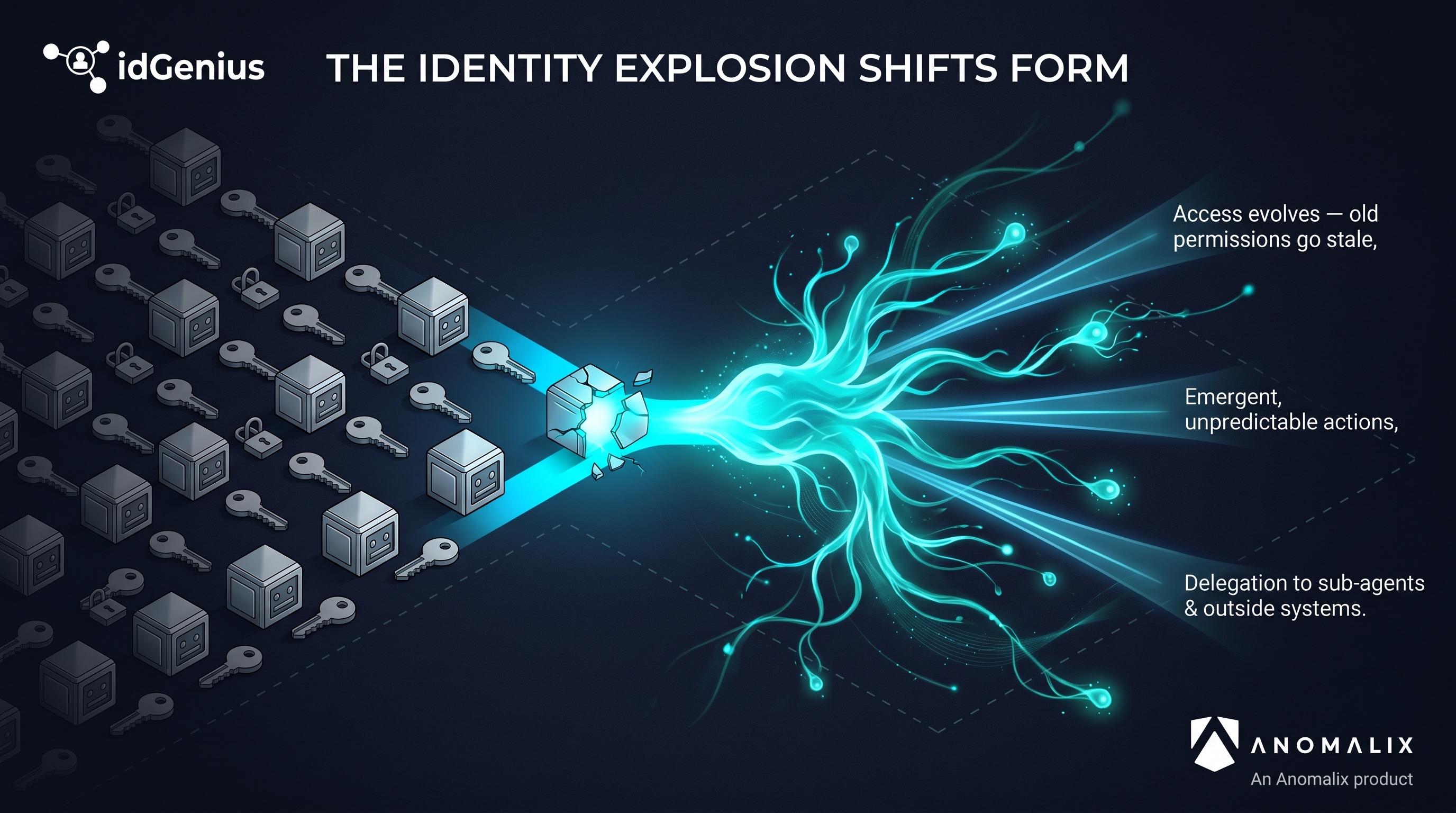
idGenius: Governing Internal and External AI Agents and NHIs Across Organizational Boundaries
Read the article
Right there, near you, some automated program acts without anyone saying yes. Built once to handle buying stuff, given access keys, linked to company tools and an outside service. That work ended weeks back. Yet it keeps going - logging in, reaching out, passing jobs to helpers it wakes up when needed. No person watches over it. Ask about its actions last month, who saw what, and truth is, you would not know where to start.
This is not some imaginary test. What you're seeing now is what actually happens when agentic AI moves into companies - which it already did, quietly, over a year and a half. Most systems meant to manage access were never made for this kind of shift. Machines pretending to be users have long been more common than real people - often sixty times over. But here’s the change: these aren’t static bots waiting around anymore. They think through steps. Take multiple connected actions. Create smaller helpers on their own. Slowly, they cross boundaries - slipping between your team, outside suppliers, joint projects, even distant AI tools tied into daily work.
Years back, the boundary changed - now it’s about who you are. With agentic AI, the toughest piece has slipped beyond where your oversight tools reach.
The Identity Explosion Shifts Form
A long time ago people mostly talked about non-living users like service accounts, API keys, or bots that followed fixed routines. These weren’t alive but had access. They’d log in, run their task, then stop - always acting just as built. One by one they showed up in systems, doing repeatable work without surprises. Watching over them wasn't easy, yet possible - track where they appeared, assign responsibility, limit what they could do, remove when outdated. Control stayed within reach because nothing changed much. Their roles rarely grew beyond original design. Rules applied cleanly since behavior didn’t shift overnight. Each piece fit into known patterns. Overseeing meant checking boxes regularly. Nothing ran wild back then.
Something shifts when agents enter the scene. Not just another tool ticking off tasks one after another. Instead, picture something that takes a direction and runs with it. Shaped less by preset rules, more by what happens around it. Given the same start point, two might end up worlds apart simply due to where they’ve been pulled next. What matters most isn’t setup - it’s response. A live thing bending course midstep based on signals, inputs, nudges along the way. By week’s end, identical origins mean nothing if paths diverge early enough.
This shifts the risks in three clear directions. Right away, because access evolves as the agent operates, initial permission limits become outdated once it begins adapting on its own. Instead of fixed behaviors, actions arise unpredictably - making rigid rules blind to real usage. What also happens is delegation: smaller helpers or outside systems get pulled in, carrying fragments of trust while skipping oversight entirely. Without your permission, it happened. On your account, the agent opened the door when you were distracted
Traditional Governance Struggles With Autonomous Identities
Working differently now, most companies still apply old systems meant for people or basic digital IDs to manage AI helpers. That mismatch shows up fast.
Out there, identity governance often follows employees - hired, shifted, or exited - tied tightly to personnel files. Not so for automated agents. These pop up without any hiring paperwork, created instead by coders, departments, outside partners, sometimes even self-replicating through other bots already running. A privileged access management system may lock down passwords and manage logins, solving part of the puzzle. Yet it stays silent on something deeper: does this bot still act as intended, when left to decide things alone? Lightweight NHI records list service accounts created by various teams recently. Yet these systems never planned for agent-driven inquiries. Accountability trails grow fuzzy fast. Someone must own each automated role clearly. Permissions granted often drift from real-world actions taken. Contracts tied to outside partners shape conduct rules. Expiration dates on access rights stay unclear too. Timelines demand transparency just as much.
Left hanging, these questions bring back old problems - credentials without owners, too much access handed out freely, hidden permissions slipping under the radar - but now they spread faster, driven by automated workflows. One overlooked agent isn’t just an idle login anymore. Think of it as a starting point, quietly branching into more, each piece holding leftover rights inside systems you’ve stopped watching.
The Hidden Cost of Unseen Limits
This is when things turn tricky. Not because of people, but because machines ignore company hierarchies entirely. Boundaries drawn on paper mean nothing to them. What separates one organization from another - legal lines, agreements - gets blurred fast.
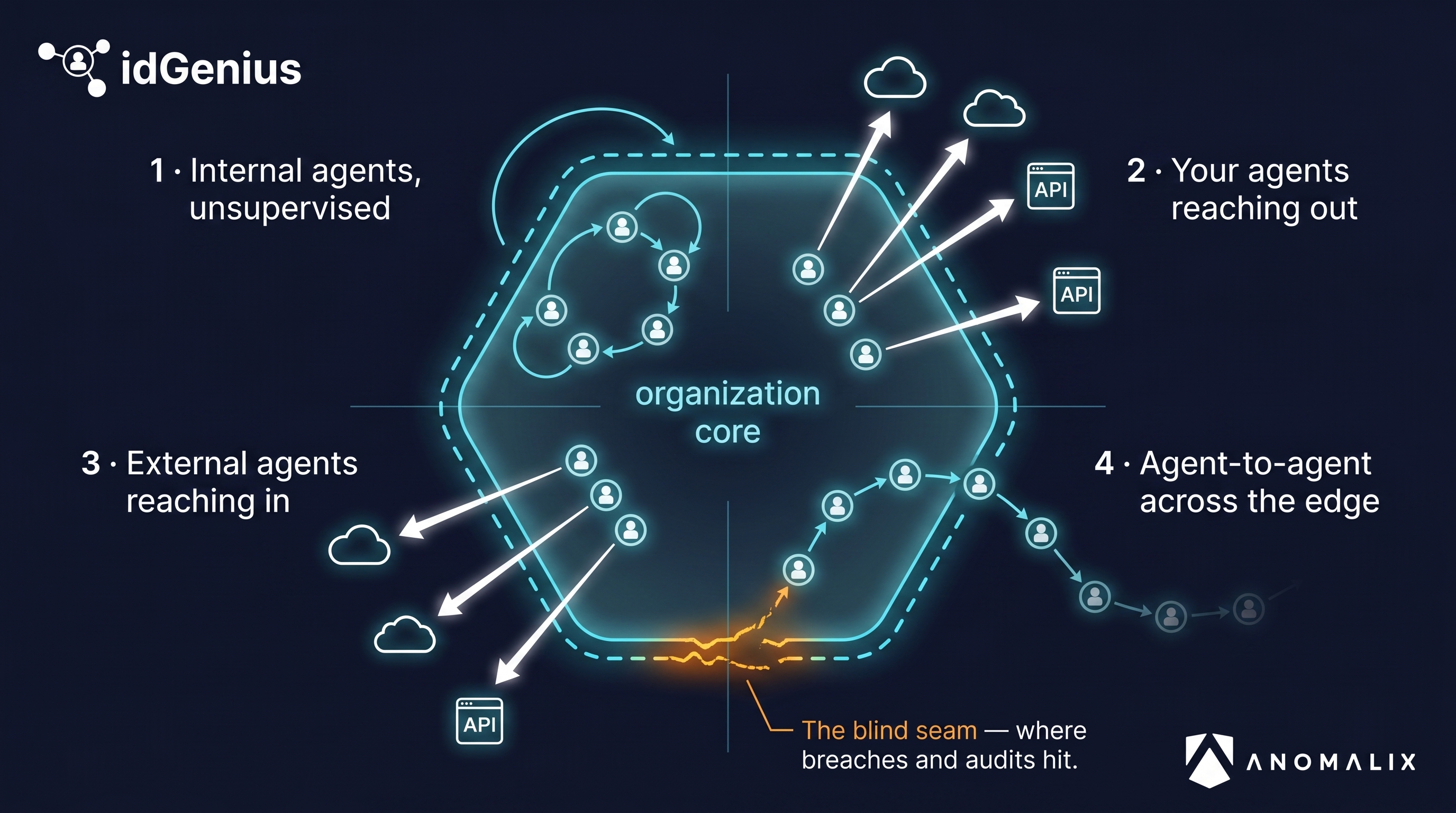
Consider the four traffic patterns already live in most environments:
- Inside your network, agents operate without oversight. These internal automations interact with critical systems and private information - highly noticeable yet often unmanaged.
- Out there, your agents log into external platforms. When one signs into a supplier’s API or a client’s system, it brings your name along - along with the risks that come with it. A single connection can stretch your responsibility across borders you didn’t build.
- Out there, someone else’s tools touch your systems. Could be a supplier’s artificial intelligence platform. Maybe it’s an outside firm running automated tasks. Or perhaps a collaborator’s software acting on behalf of another company entirely. These connections supposedly follow rules written in agreements - though hardly any setup checks those promises where access really happens.
- Across the edge, agents talk to agents. One triggers a model outside your team, which then pulls in another. Control slips through companies without one person holding it all together. No full record follows where decisions really went.
Each flow carries someone’s access rights. Yet nearly all fail to connect - properly or at all - to a company, contract, supporting party, deadline, or security stance. Reality shows they often link to no clear source. These sit stranded where oversight ends and supplier control begins, the weak spot both hackers and inspectors target fastest. Breaches tied to outside parties make up too much damage already; self-running accounts moving across that line stretch the vulnerability even further.
Governing AI Agents as Independent Entities
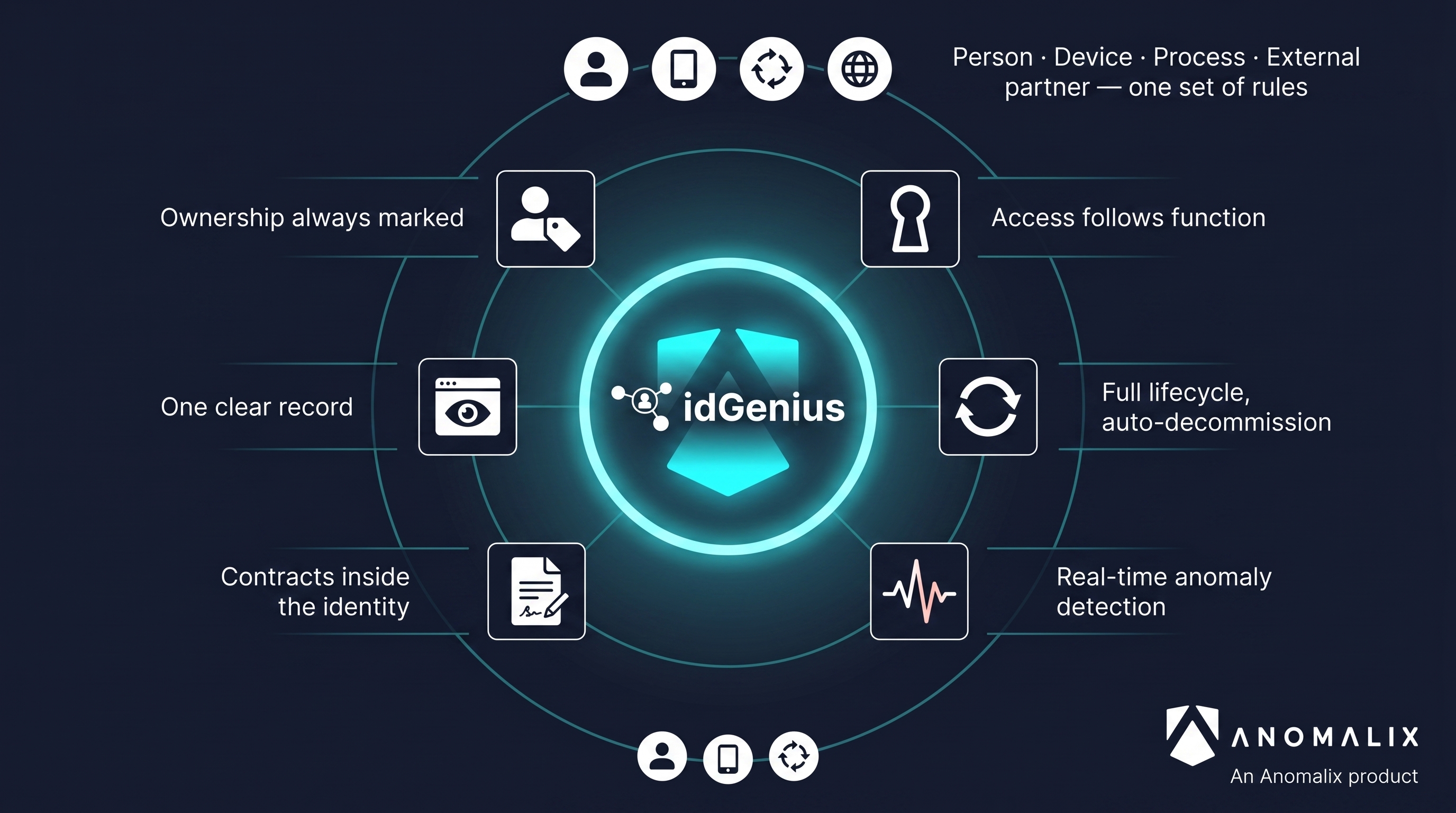
From the start, idGenius rested on an idea that still fits even as new agents appear: each identity entering your space - whether person, device, or self-running system - should follow identical rules, life stages, and responsibility checks. Far from being tacked on like an afterthought, these agents function as official identities. They live within a single view of operations, shaped and tracked just like freelancers, outside suppliers, background processes, and external groups they routinely support.
Out there, one idea slips quietly into several skills - skills that count when machines or agents move across company borders. These traits show up most where identity isn’t human but still needs access, trust, movement.
Ownership always marked. Each agent, whether inside your team or brought by a supplier, links back to a named person in charge. When it comes from beyond your company, that link includes the external group involved plus their binding agreement. A free-floating entity without oversight? That kind of exposure won’t slide. Idgenius spots those gaps fast - silence isn’t allowed.
Out here, access follows function. Because each agent exists for a specific job, what it can do lines up exactly with that task - nothing wider, nothing guessed. When work ends, permissions dissolve. A bot built for twenty-one days won’t linger past day ninety holding keys like nothing changed. Expiry dates ride along by default, baked into contracts and project clocks. No lingering behind the scenes once the reason fades. Privileges fade when purpose does.
Start to finish, each agent moves through setup, adjustments, then exit. Just like outside workers, they follow onboarding, updates, and departure steps. Once work finishes or contracts expire, automated checks remove their entry everywhere tied systems exist - far beyond main platforms - wiping out idle self-running accounts that often stay behind, creating risk.
What if machines could spot strange moves before they cause harm? Instead of relying on fixed checklists, idGenius learns by observing how automated systems behave. When something shifts - like an unfamiliar access attempt or a tool acting outside its usual role - the system flags it fast. Odd sequences stand out: a script touching new files, a bot repeating actions too quickly. Detection happens while events unfold, not months later during audits. Alerts go out when patterns twist, letting teams respond while risk is still small.
Starting with contracts, papers show who agreed to what right inside the ID. When outside helpers act, they carry duties passed down from deals their main company made earlier. Instead of scattered files, idGenius tucks every signature, deal, and permission directly into the person’s profile. Rules then follow actual responsibility - no guesswork - who owns which duty becomes clear by design.
Someone sets the rules. Others follow them safely. Teams handle tasks they know well using clear steps everyone agrees on. Oversight stays tight but invisible. People work freely inside strong boundaries. One view keeps leadership informed. Power spreads out yet holds together. Requests skip long waits. Control shifts without risk.
That moment captured clearly. If someone questions who accessed a specific system on a certain day - along with actions taken and timing of permission removal - the reply comes fast: one clear document instead of digging through logs.
Zero Trust for Thinking Machines
Midnight decisions by software can surprise even familiar suppliers. When an automated system acts alone, past reliability offers no guarantee. Trust built over years vanishes if one unseen process misbehaves. Familiar names mean little when code runs without supervision. What a company did yesterday says nothing about its agent’s choices tonight.
Start by treating every automated worker like someone with access to the vault. Check who they claim to be, each time, without exception. Because permission should depend on what they’re doing right now, not just their job title. Limit their reach to only what is needed, nothing extra lingers nearby. Watch how they move, notice if something shifts even slightly from the norm. When actions stray beyond expected patterns, respond - automatically. idGenius handles this exact routine but built solely for bots, scripts, and background processes. These aren’t people, yet they demand equal scrutiny. Traditional systems overlook their habits, their risks, their scale. This tool fills that gap quietly, working alongside what you already run instead of tearing it down.
Early choices shape outcomes. Firms succeeding here avoid banning tools or hoping issues fade. Instead, they assign ownership to each automated entity from the start. Each has clear limits, a timeline, tracking records. Their systems evolve fast enough to keep up. Control follows function. Rules apply in real time. Boundaries are set, watched, updated. Structure moves with pace. Oversight stays active.
Out there, agents are multiplying - inside your systems, inside partner networks. This season, pose a basic query to your crew: picture needing to list every AI actor, every digital presence granted entry, even those outsiders introduced through suppliers - right now, today, would such a tally exist?
Surprised by the response? That means it’s time to talk. Get in touch at info@anomalix.com to discover how idGenenus brings clarity, oversight, and responsibility to AI agents, machine identities, along with their external partners - exactly what this new phase of automation requires.
Bridging the Vendor Compliance Gap with idGenius
Read the article
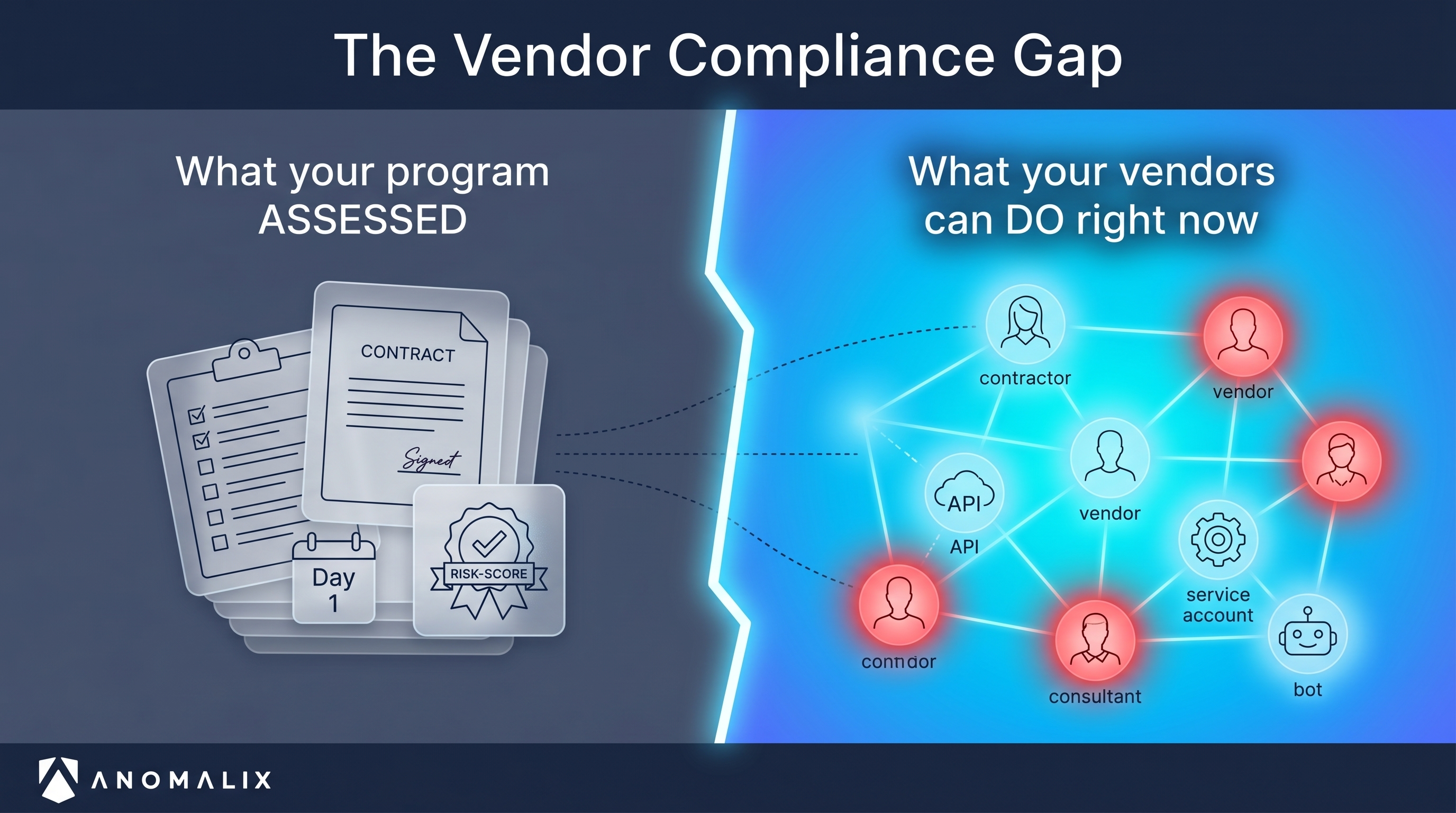
Your last vendor risk assessment might have been right - until tomorrow changed everything.
Here it is - the awkward reality many in security and compliance quietly accept. You issue the form. The supplier answers neatly. Lawyers attach proper terms. Signatures follow. Yet once things start up, roles shift, temporary staff come and go, someone sets up an automated access channel to move information across platforms, and soon enough, the clear picture of risk you thought you had slips away, replaced by something far messier than paper trails suggest.
Here lies the problem with vendor rules. What your outside security plan thinks is true often misses what vendor accounts are really doing inside your tech today. Forms, promises, and legal terms capture only one point in time. These tell you nothing about login rights still active weeks after work stops, the advisor with too much reach who never got reviewed again, or the secret code pulling files long past its due date.
Watchdogs are paying attention now. Criminals too. A 2025 report by Security Scorecard showed over one-third of last year’s data leaks came through outside partners. Meanwhile, research from Imprivata and the Ponemon Institute claimed it's worse - close to fifty percent of companies faced a security incident tied to vendors within just one year. What fuels these incidents isn’t some high-tech trick. It’s leftover logins. Old passwords left active. Accounts abandoned but still live, meant to be shut down yet somehow missed.
That gap won’t shut with extra forms. Fix what holds the risk instead - identity itself.
Traditional TPRM Stops Early
Out there, most third-party risk setups were built for slower times - long-term suppliers, clear roles, just people logging in. Those days have faded. Today’s company works with countless outside firms, every one adding layers: freelancers, experts on contract, tech teams running remotely. On top of that come machines acting alone - scripts, automated tasks, robot processes, connections between software - all talking across company lines without a person in sight.
Most digital IDs inside big companies won’t belong to people, experts say. Once bots and systems outnumber staff, checking access only at the start isn’t a policy flaw - it’s baked into the setup
- A single check loses value fast. Right when you start, things shift. One form shows just one moment. Live access moves as people act. These paths split immediately.
- Most daily choices about who gets in happen here and there. While procurement holds the contract, IT handles setup. The business manages contact, yet nobody takes full responsibility for identity. Gaps appear where duties meet.
- Out there among the lines, machine identities stay hidden. Hidden too are APIs - alongside service accounts - not showing up much in what vendors write. Even so, these unseen elements tend to carry wide access. Their permissions stick around longer than most.
- Someone has to recall for offboarding to happen. If a contract simply fades out, nothing triggers. Permissions stick around anyway. Each old account adds another crack where trouble might get in.
What you get is a system that looks solid in theory yet full of holes when tested. Passing inspection doesn’t mean safety, since checks focused on paperwork while attackers exploited login details.
Vendors As Governed Identity Groups
What really changes things begins in how you think, not what tools you use. Forget seeing a vendor just as a deal you reviewed on paper. Picture it instead as a crowd of roles - some people, some systems - all linked to someone responsible, with clear limits, levels of danger, their own clocks ticking down, rooted in the agreement that let them in.
Right now, if identity is how you track who a vendor really is, then everything about your risk checks turns into something you can prove on the spot. Rather than wondering whether some outside company cleared an old review, you shift to what actually matters: Who exactly from their team is inside your systems at this second. What parts of your data or tools are those people touching. Whether any of it goes beyond what was signed off in the agreement, given where your risks stand today.
Built on that idea, idGenius brings together workers outside the company - contractors, suppliers, allies, experts, tech support services, even machines - into one clear record. Each profile gets extra details most systems ignore: when contracts start and end, job numbers, which team invited them, their qualifications, how much risk they carry. Access rights link directly to actual work tasks. Identities fade out once purpose fades. Assessment data and entry permissions begin aligning, since both follow the same structure now.
What Autonomous Really Means
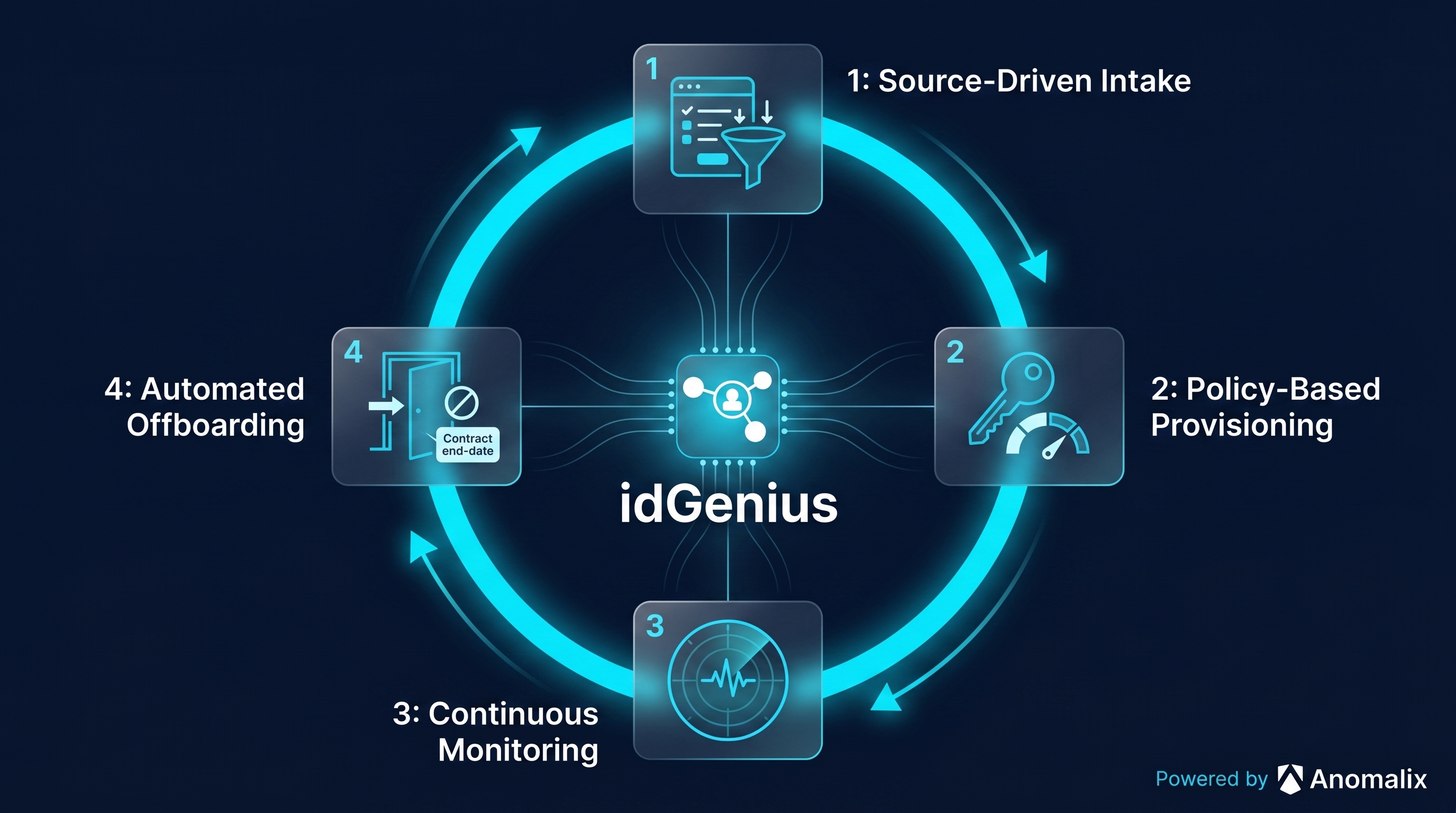
Out there, automated outside help handling isn’t just saying “AI inside.” That label fits when actions feed into each other, never pausing for someone to wake up and act. One piece follows another - four pieces actually - that turn the idea into something you can touch.
Out of the gate, source-driven intake ditches spreadsheets entirely. Instead of scattered files, business sponsors log identity details right when they onboard someone. Workflow prompts make sure every piece fits - what kind of access, which systems, who signs off. Information flows in only after checks clear, blocking messy entries up front. Accuracy kicks things off, not cleanup later. Governance gains ground because it begins with clean facts.
Automatic enforcement of least privilege happens through policy rules. One project’s contractor gets no extra rights just because a permanent collaborator has them. Access comes from role, project needs, or assessed risk levels. Higher-stakes situations trigger additional checks before approval. The system handles decisions internally, skipping message threads entirely.
Access stays accurate because the system updates itself automatically. Each new hire, role change, renewal, or departure kicks off an instant review. As responsibilities shift, permissions shift with them. Once a contract expires, exit routines activate by design - cutting entry to cloud folders, team platforms, internal networks, remote connections, and online services, beyond just the main login. That leftover account - the top cause of outside risks - just disappears when it's no longer needed.
What if your security could learn? idGenius watches how identities act, then spots when something shifts. Not every change is risky, but timing matters - like logins at odd hours. Access patterns evolve, yet sudden moves stand out. A forgotten API key waking up might mean nothing. Or it might need attention. When behavior drifts too far, responses happen fast: permissions shrink, sessions stop, alerts rise. Risk isn’t just caught. It’s shaped ahead of time.
What really lets the system grow isn’t more people. Instead, one rule set applies uniformly across countless vendors. A single setup handles loads of accounts quickly. The tool takes over tasks too slow for manual checks. Scale comes from consistency, not effort.
Governing What Was Left Out of the Records
What sets dedicated third-party oversight apart from broad identity systems forced into the role? A pair of distinct strengths. Each tackles the compliance shortfall head-on, yet in its own way. One pins down accountability where it's weakest. The other tightens control at access points most often overlooked.
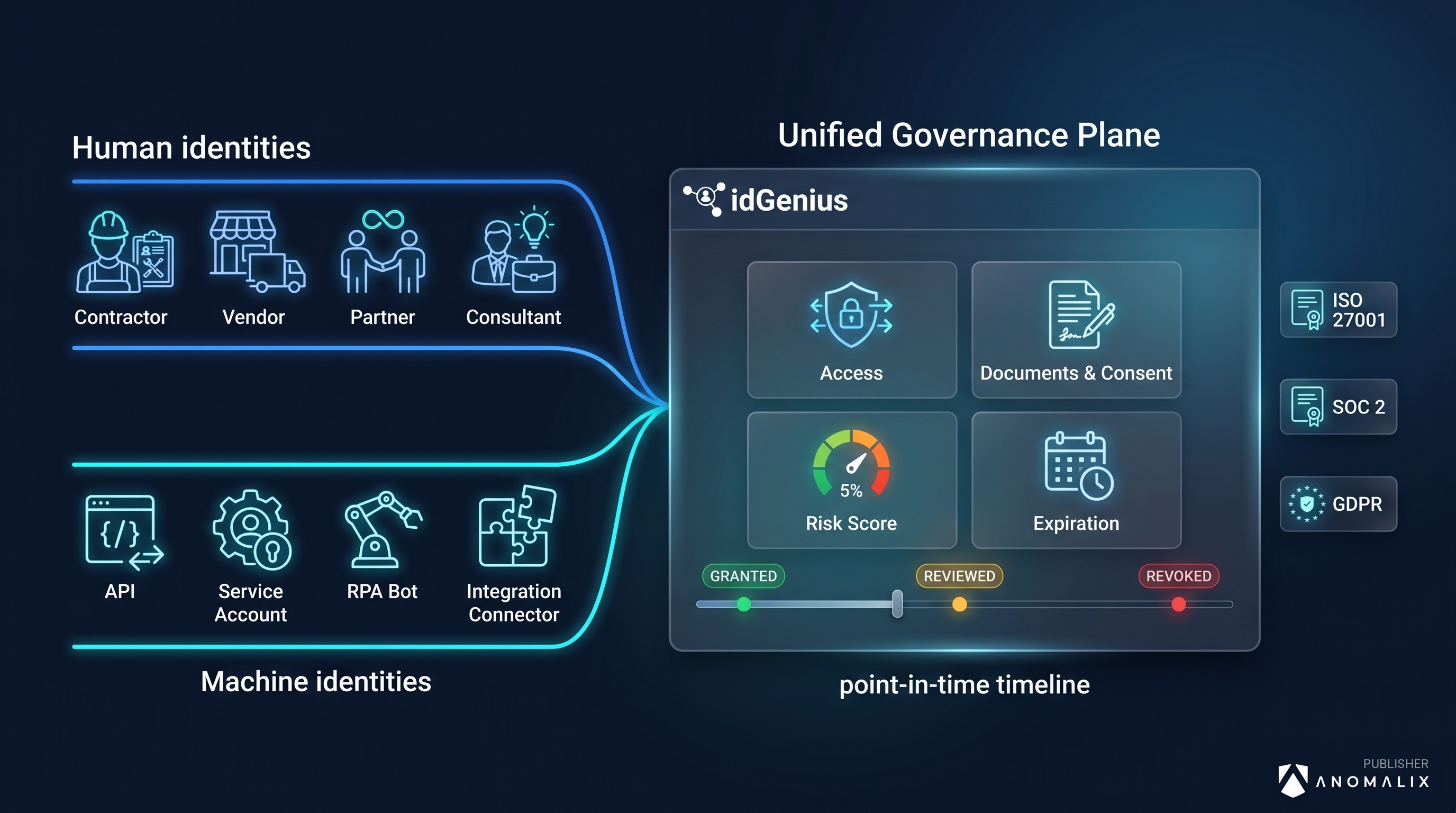
One key part handles documents and permissions. Identities in business settings come from outside companies tied to main service contracts, confidentiality deals, licensing rules, along with data protection duties. Keeping those papers linked directly to the user profile - using digital signatures plus oversight of approvals in one place - ensures the reason for access sits right beside it, reachable instantly. If someone checking compliance questions a permission’s purpose, the explanation travels with the account, instead of hiding somewhere in a forgotten file system.
Next comes seeing things exactly as they stood at any given moment. Standards such as ISO 27001, ISO 31000, SOC 2, HIPAA, GDPR now expect proof not only of current access but also past access - who held it, when, and the reason behind it. Instead of guessing, idGenius captures snapshots of each outside user's permissions right when changes occur. Preparing for audits shifts from chaotic last-minute scrambles to a quick search. Gathering proof goes from taking days down to mere minutes. Since data is recorded live, during actual events, there’s no need to piece together what might have happened later on.
Here’s where things shift toward real-world usefulness. Most extended IGA tools manage people well enough, especially temporary workers, yet still miss key parts like automated system identities, personal data handling, or permission tracking. Built right from the start, idGenius fits neatly beside your current access systems - adding tighter controls across vendor networks while letting your present setup stay exactly as it is.
Cost Center Becomes Strategic Control
Right now, companies doing this well aren’t only cutting down risks - they’re reshaping how governance costs work. With unused and high-permission accounts removed automatically, exposure drops without extra effort. Getting people started moves faster since access follows a clear plan, not random approvals from each supervisor. Being ready for audits turns into normal routine instead of last-minute panic every few months. Security staff spend less time fixing outside access problems, shifting those hours to tasks that truly move things forward.
Out here, scaling trust comes down to delegation. When departments invite partners, they follow preset paths - each step shaped by policies baked into the system. Oversight stays tight because automation handles limits and deadlines behind the scenes. Those closest to the work get room to act, since rules stay firm even when hands-off. Balance shifts: moving fast no longer means cutting corners.
Closing the Gap Before It Closes On You
Outsiders aren’t rare guests anymore inside your setup. Most now, they move through the weakest gates leading straight to what matters most. Fixing vendor rules won’t help if you just tweak forms or tighten wording - risk wasn’t hiding in paperwork anyway. Lived-in logins, shifting roles, silent upgrades in power - that’s where danger lives, long after checks were signed off.
Out in the open, trust isn’t assumed - it’s proven again and again. IdGenius checks each outside user right when they enter, applies rules automatically, manages access from start to finish, and keeps records clear for review - whether it’s a person or a system needing entry, no matter how large the network grows.
Right now, your tool might track who you’ve reviewed - yet miss what vendors are actually doing today. That difference? It’s the first thing to measure. Imagine seeing exactly where third-party access risks live across your systems. Picture how automated oversight fits within your actual setup - we’re ready to walk through it with you.
Got questions about third-party access? Try info@anomalix.com. That email connects you to a team checking identity setups. One tool they look at is idGenius. It manages outside workers - contractors, vendors, partners. Confidence comes from clear oversight. Security tightens when systems track who does what. Scaling up needs structure, not guesswork. The platform adapts as teams grow. Risks drop when visibility increases. Every login gets reviewed. Control improves without slowing work down.
HIPAA 2026 Just Changed the Rules on Third-Party Access. Is Your Identity Program Ready?
Read the article
The 2026 HIPAA Security Rule overhaul isn't a paperwork refresh — it's a compliance reset. Here's what changed, why most organizations aren't ready, and how idGenius from Anomalix gives you the infrastructure to stay ahead.
Let's be direct: if your approach to HIPAA compliance still starts and ends with a signed Business Associate Agreement and an annual audit, you're operating in a framework that no longer exists. The Department of Health and Human Services finalized its most sweeping rewrite of the HIPAA Security Rule since 2003 — and the changes land squarely on the one area most organizations have historically underinvested in: third-party identity governance.
This isn't a situation where you can catch up with a policy revision or a quarterly vendor survey. The 2026 updates introduce continuous, provable controls — not just intent. For CISOs in healthcare and for every business associate that touches electronic protected health information, that distinction changes everything.
WHAT ACTUALLY CHANGED — AND WHY IT MATTERS
The end of "addressable" safeguards
For years, HIPAA's Security Rule gave organizations a convenient escape hatch: the "addressable" implementation specification. If a control was listed as addressable, an organization could document why they chose an alternative — or decided not to implement it at all — and remain technically compliant. That flexibility is gone.
Under the 2026 rule, every technical safeguard is mandatory. There are no more judgment calls about whether MFA is appropriate for your environment, or whether granular access controls are "reasonably necessary." If your vendors and contractors access ePHI, they need MFA. Full stop. If they have access, that access must be role-based, scoped to the minimum necessary, and actively managed.
Documenting intent is no longer enough. Under the 2026 HIPAA Security Rule, organizations must demonstrate that controls are actually operating — not just written into a policy manual.
The 1-hour access revocation mandate
Here's the provision that should immediately trigger an operational review if you haven't had one. The updated rule requires that vendor and employee access be revoked within one hour of a termination event or contract end. Not within a business day. Not the next morning. Within sixty minutes.
Think about what that requires operationally. You need a direct, automated line from your HR and contract management systems to every ePHI-connected environment — EHRs, cloud infrastructure, SaaS applications, network systems. Manual processes don't work here. A deprovisioning ticket that sits in a queue overnight is now a compliance violation waiting to happen.
Annual written verification — from every business associate
This is the provision that will generate the most operational overhead for compliance teams. Covered entities are now required to obtain documented, written proof — annually — that each business associate has implemented all required technical safeguards. A signed BAA doesn't satisfy this requirement on its own anymore. You need verified evidence.
Given that OCR levied over $6.6 million in fines in 2025 — with the largest single penalty tied to a breach originating from a compromised business associate — this isn't a theoretical risk. The weakest link in your vendor chain is your liability. Regulators have made that point clearly.
WHY MOST ORGANIZATIONS ARE EXPOSED RIGHT NOW
The uncomfortable reality is that most healthcare organizations have built their identity infrastructure around their own employees. IAM systems authenticate and enforce access for internal users. IGA platforms govern the lifecycle of identities tied to HR systems. Vendor risk management tools assess organizational security posture at a high level.
None of these were designed for the problem the 2026 HIPAA updates are actually targeting: the external identity.
The third-party identity gap
When a vendor's employee logs into your EHR to run a maintenance job, where does that identity live in your governance model? In most organizations, the honest answer is: nowhere structured. That user was probably invited by a business stakeholder who bypassed IT, provisioned with broader access than necessary for convenience, and never formally reviewed.
That same user may still have access three years later, long after the project ended. That's not a hypothetical edge case. It's one of the most common findings in HIPAA breach investigations.
Identity governance gaps in third-party access are consistently among the top contributors to healthcare data breaches. The 2026 rule is designed specifically to close that gap.
Why traditional tools fall short
IAM systems are effective at enforcing access, but they assume control over the identity lifecycle — which doesn't hold for external users managed outside your directory. IGA platforms govern structured identity sources like HR systems; vendors don't follow those patterns. The result is orphaned accounts, excessive access, and limited visibility into who, exactly, has their hands on your ePHI.
Patching these gaps with spreadsheets and quarterly review emails isn't scalable under the new rule. You need a purpose-built approach to external identity governance.
WHAT IDENTITY-CENTRIC COMPLIANCE LOOKS LIKE IN PRACTICE
The shift the 2026 rule demands isn't really about technology — it's about treating identity as a security and compliance foundation, not an afterthought. Here's what that looks like operationally:
• Every external user is visible in a centralized system of record, linked to their organization and their purpose.
• Access is governed by policy from day one — not provisioned ad hoc and reviewed later, if at all.
• Deprovisioning is automated and fast — triggered by contract end or termination, not by a human remembering to submit a ticket.
• Periodic access certifications are scheduled, structured, and captured as audit evidence — not handled through email threads.
• Compliance status per business associate is available in a format that satisfies annual written verification requirements.
This is the standard the 2026 rule sets. It's also the standard that separates organizations that will weather an OCR audit from those that won't.
HOW IdGENIUS ADDRESSES THE 2026 MANDATES
idGenius is Anomalix's identity governance and administration platform, built for exactly this environment — one where access must be continuously governed, every vendor identity must be visible, and compliance must be demonstrated in verified evidence, not paperwork.
Access governance and least privilege enforcement
idGenius automatically enforces least-privilege access policies across employees, contractors, and third-party vendors. Access to ePHI is scoped precisely to what each role requires. When roles change, access changes. When entitlements drift outside defined parameters, the system flags it — and can trigger automated remediation before it becomes an audit finding.
Automated provisioning and 1-hour deprovisioning
When a vendor contract ends or an employee is terminated, idGenius triggers automated deprovisioning workflows that revoke access across all connected systems within minutes — consistently inside the new 1-hour mandate. This isn't a best-effort process dependent on someone remembering to pull access. It's an automated, auditable workflow that runs every time.
Third-party identity visibility and risk scoring
idGenius gives compliance teams a consolidated view of every third-party identity with access to your ePHI environment, enriched with risk scores, access history, and current compliance status. This is the evidence base you need for annual vendor verification — packaged in a format aligned with OCR audit requirements.
Access certification campaigns
Scheduled certification campaigns route entitlement decisions to the right reviewers, capture approvals and rejections as timestamped audit evidence, and automatically remediate over-provisioned accounts. The result is a structured, repeatable review process that satisfies the updated periodic review requirements — without manual overhead.
Separation of duties and toxic access detection
idGenius continuously monitors for conflicting entitlements and toxic access combinations across user and vendor accounts. Violations are automatically flagged and routed to risk owners for remediation — in real time, not during the next quarterly review.
From Compliance to Continuous Control: The Anomalix Perspective
At Anomalix, we see the 2026 HIPAA changes as a turning point—not just for compliance, but for accountability. Organizations can no longer rely on static policies; they need continuous visibility into who has access and why. That’s why we built idGenius: to help teams move from reactive audits to proactive control, ensuring every identity—especially third party—is governed, verified, and secure in real time.
THE BOTTOM LINE FOR CISOS
The 2026 HIPAA Security Rule is the most significant regulatory shift in healthcare data protection in over two decades. Organizations that approach it as a documentation exercise will find themselves exposed — both to enforcement action and to the exact breaches the rule was designed to prevent.
The third-party provisions, in particular, demand a level of continuous, automated identity governance that manual processes can't deliver at scale. The question isn't whether your organization needs this capability. It's whether you're building it before an incident forces the issue.
idGenius turns compliance from a checkpoint into a continuous operational capability — and transforms third-party identity governance from your biggest risk exposure into a verifiable competitive advantage.
Organizations that invest in this infrastructure now won't just satisfy regulators. They'll operate with more confidence, respond to incidents faster, and reduce the operational drag of scrambling to produce evidence that should have been captured automatically all along.
Ready to assess your HIPAA readiness?
Speak with an Anomalix identity governance specialist to see how idGenius maps to your current environment — and where your third-party risk exposure actually lies.
Contact us at info@anomalix.com or visit anomalix.com
From Compliance to Strategic Advantage: Rethinking Third-Party Risk Management
Read the article
Introduction: The Evolution of Third-Party Risk
Modern enterprises rarely operate within the boundaries of a single organization anymore. Today’s businesses depend on a vast ecosystem of vendors, contractors, suppliers, service providers, consultants, and partners. These external entities enable innovation, accelerate delivery, and provide specialized expertise—but they also introduce one of the most complex risk surfaces organizations must manage.
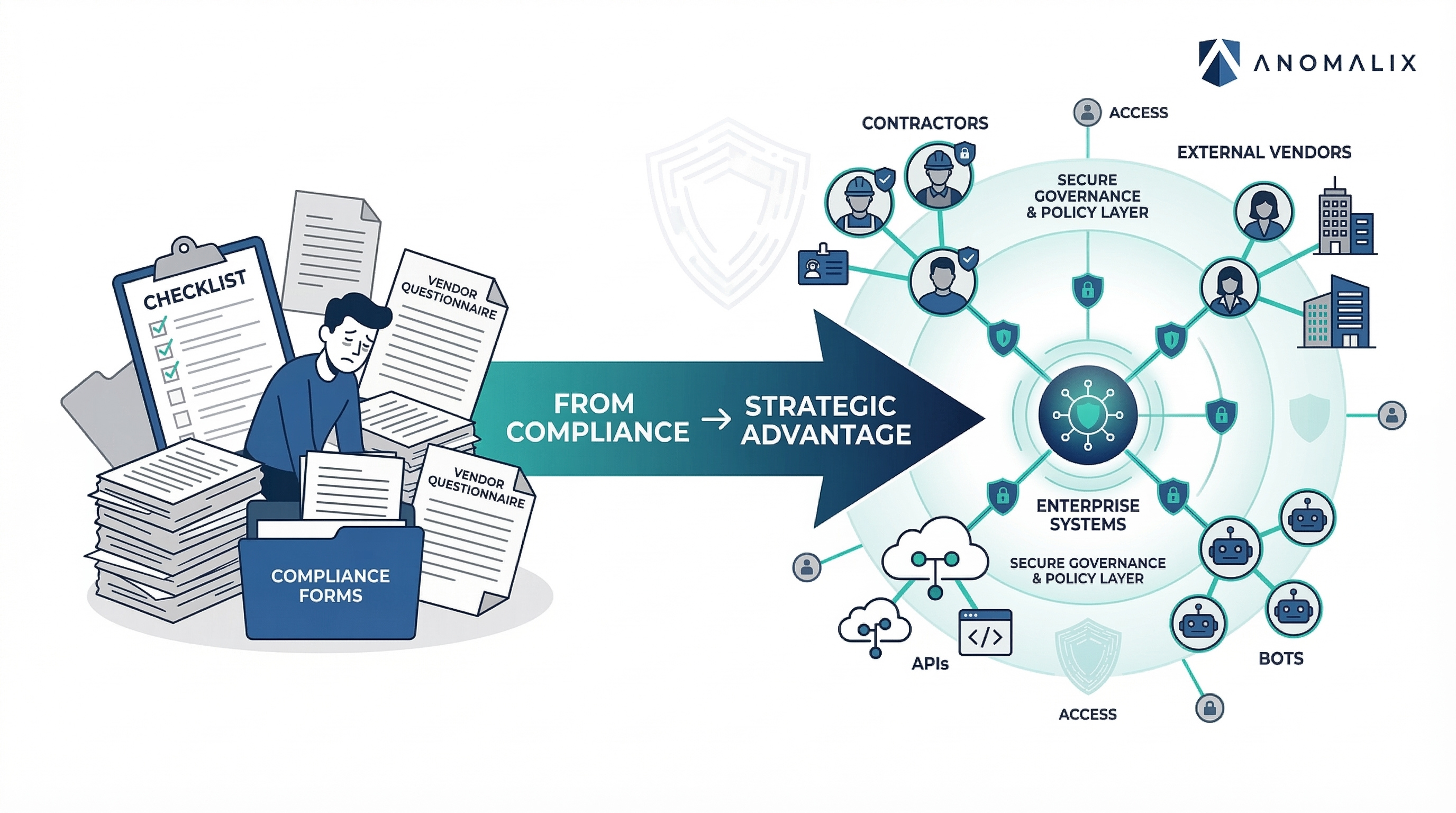
Third-party risk management (TPRM) was originally designed as a compliance-driven function. Organizations assessed vendors through questionnaires, contractual obligations, and periodic audits to ensure they met regulatory expectations. While these controls remain important, they are no longer sufficient for the realities of the modern digital enterprise.
The reason is simple: risk now flows through identities and access, not just through contractual relationships. Vendors, contractors, and external service providers frequently access sensitive systems, data, and infrastructure. Yet many organizations still govern these relationships primarily through documentation rather than operational control.
At Anomalix, we believe the next evolution of TPRM lies in shifting from compliance-driven oversight to identity-driven governance. When organizations rethink third-party risk management as a strategic identity security capability, they unlock not only stronger protection but also improved business agility and trust across the extended workforce.
Why Traditional Third-Party Risk Management Is No Longer Enough
Historically, third-party risk management focused on evaluating vendors before engagement. Security teams would review certifications, examine policies, and verify compliance with frameworks such as SOC 2, ISO 27001, or PCI DSS.
While these practices remain necessary, they have a fundamental limitation: they evaluate the organization, not the identities interacting with your systems.
The traditional TPRM model typically includes:
- Vendor security questionnaires
- Contractual security clauses
- Periodic vendor risk assessments
- Annual or quarterly compliance reviews
- External security ratings
These processes provide valuable insight into the security posture of the vendor organization, but they rarely control what individual vendor identities can actually access inside your environment.
This gap creates several critical issues:
1. Access Decisions Happen Outside the Risk Program
While procurement and risk teams evaluate vendors, the operational reality is that access decisions are often made by business units, IT teams, or application owners. These decisions frequently occur through ad hoc processes such as tickets, email requests, or direct account creation.
As a result, access governance becomes fragmented, inconsistent, and difficult to audit.
2. Risk Is Static While Access Is Dynamic
Traditional TPRM assigns vendors a risk rating that rarely changes until the next assessment cycle. Meanwhile, vendor employees, contractors, and machine identities gain and lose access continuously as projects evolve.
Without real-time identity governance, risk quickly drifts away from the original assessment.
3. Compliance Doesn’t Equal Security
Organizations may technically pass vendor assessments and still experience breaches through third-party identities.
A vendor can have strong security controls internally while their accounts inside your systems remain:
- Over-privileged
- Poorly monitored
- Untracked after contract termination
This disconnect between compliance and operational access control is where many modern security incidents originate.
The Extended Enterprise: Where Third-Party Risk Lives Today
Modern enterprises operate as interconnected ecosystems rather than isolated organizations.
Cloud platforms, SaaS applications, managed service providers, offshore development teams, system integrators, and API-based integrations all require external access to internal systems.
This creates what many security leaders call the extended enterprise—a network of identities operating across organizational boundaries.
In many large organizations, the number of non-employee identities now equals or exceeds the number of employees. These include:
- Contractors
- Consultants
- Vendor personnel
- Managed service providers
- Partner organizations
- Temporary workers
- Machine identities such as APIs, bots, and service accounts
These identities often access the same systems and data as internal employees, yet they frequently lack the same governance controls.
From a risk perspective, this imbalance creates a dangerous blind spot.
Third-party identities tend to:
- Exist outside HR systems
- Follow inconsistent onboarding processes
- Have unclear ownership or sponsorship
- Accumulate privileges over time
- Persist long after the engagement ends
Without proper governance, these identities quietly expand the organization’s attack surface.
The Real Problem: Third-Party Identities Fall Between Systems
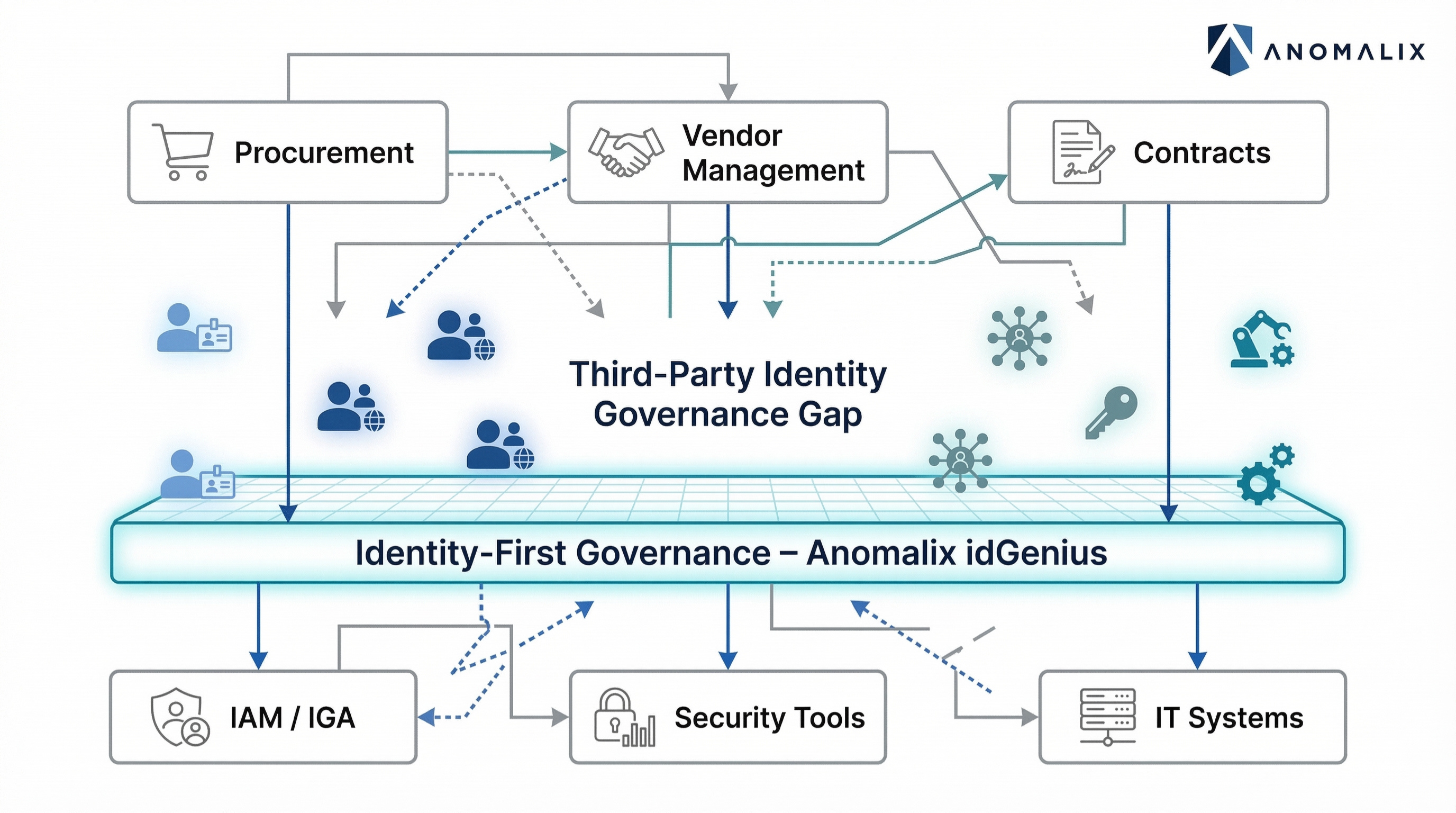
One of the biggest structural challenges in modern cybersecurity is that third-party identities do not clearly belong to any existing control system.
Different departments manage different aspects of vendor relationships:
Function
Focus
Procurement
Contracts and vendor selection
Vendor Management
Relationship governance
IAM
Employee identity management
Security Operations
Monitoring and threat detection
IT
Account provisioning
None of these systems fully govern the lifecycle of third-party identities.
Traditional identity and access management tools rely heavily on HR systems as the source of truth, which works well for employees but fails for external identities that originate from contracts, projects, or vendor relationships.
This creates a governance gap where:
- Vendor contracts exist without linked identity controls
- Identity accounts exist without lifecycle ownership
- Security tools see activity but lack business context
Closing this gap requires a fundamentally different approach to third-party risk management.
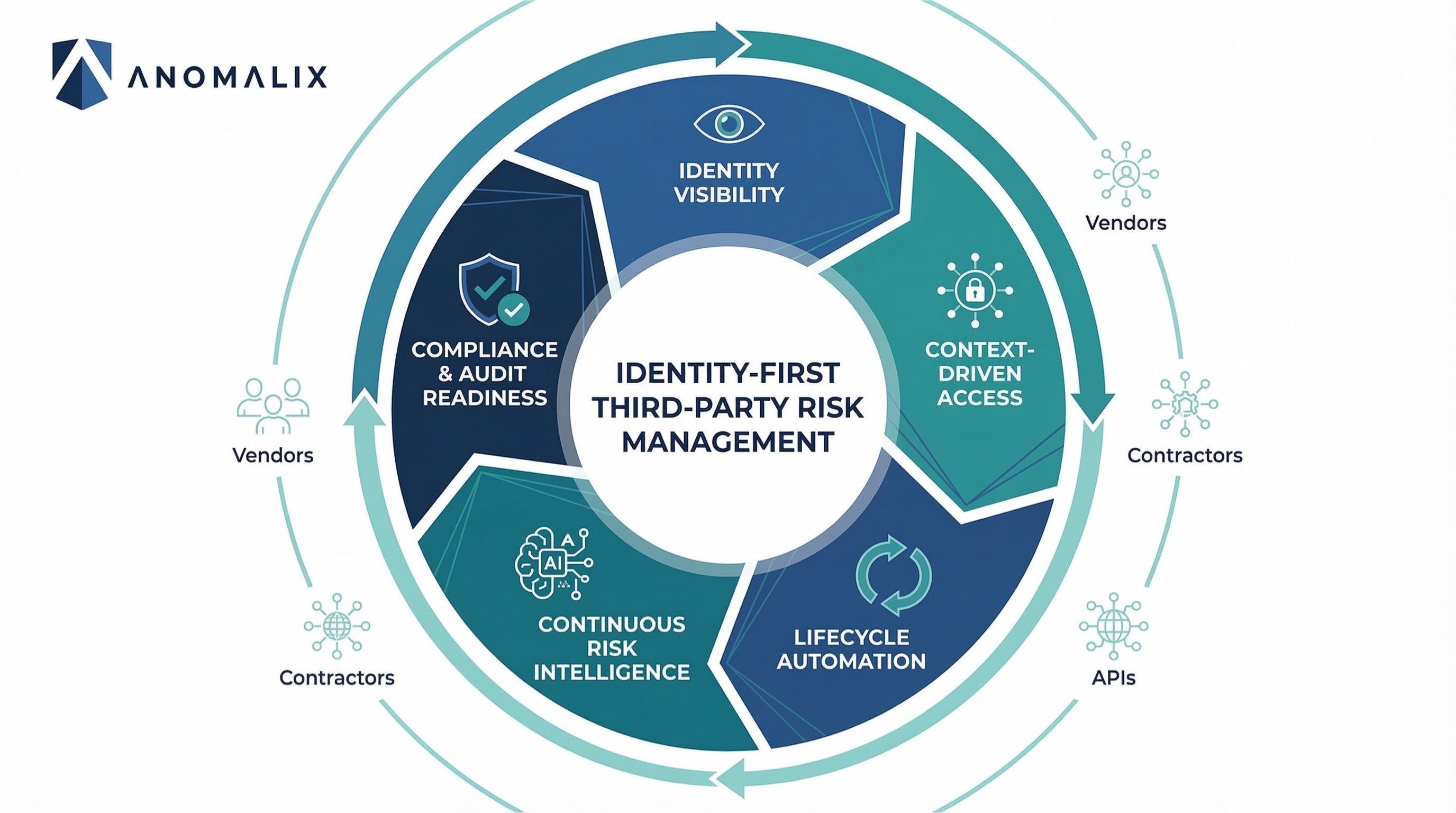
Identity-First Third-Party Risk Management
At Anomalix, we believe the future of TPRM is identity-first.
Identity-first third-party risk management shifts the focus from evaluating vendor organizations to governing the identities that interact with your environment.
Instead of asking:
“Is this vendor trustworthy?”
Identity-first TPRM asks:
- Which identities from this vendor have access?
- What systems and data can they reach?
- Why do they need that access?
- Who is accountable for it?
- When should it expire?
This shift transforms TPRM from a periodic assessment process into a continuous operational security capability.
Identity-first vendor governance ensures that every external identity is:
- Known
- Accountable
- Contextualized
- Time-bound
- Continuously monitored
This approach connects risk management directly to access governance, closing the gap between policy and operational security.
From Compliance Exercise to Strategic Capability
Organizations that rethink TPRM through an identity-first lens begin to see a significant transformation. Third-party risk management evolves from a reactive compliance task into a strategic business enabler.
1. Real-Time Visibility into the Extended Workforce
Identity-centric governance creates a centralized inventory of all external identities and their access.
Security teams gain visibility into:
- Third-party organizations
- Individual users and machine identities
- Access privileges and entitlements
- Project assignments and contract timelines
- Sponsoring business units
This level of transparency allows organizations to understand their true attack surface.
Without this visibility, security teams cannot answer even basic questions about external access.
2. Access Aligned with Business Context
Traditional access provisioning often happens without understanding the broader business relationship behind the request.
Identity-first TPRM ties access decisions directly to:
- Vendor contracts
- Project assignments
- Sponsoring departments
- Risk ratings
This ensures that external identities receive only the access required to perform their tasks, reinforcing least privilege principles.
Over time, this dramatically reduces the number of excessive permissions and dormant accounts in the environment.
3. Lifecycle Governance Instead of One-Time Reviews
External identities often move between roles, projects, and organizations. Their access needs change frequently.
An identity-first approach governs the entire lifecycle of these identities:
- Structured onboarding
- Policy-driven access provisioning
- Automated access adjustments
- Time-bound entitlements
- Automated offboarding
When access is tied directly to engagement timelines, dormant accounts disappear by design rather than by manual cleanup.
4. Continuous Risk Intelligence
In traditional TPRM programs, risk assessments occur periodically.
Identity-first governance enables continuous risk monitoring by linking identity activity to security analytics.
Risk signals may include:
- Unusual access behavior
- Dormant accounts
- Privileged entitlements
- Access from unexpected geographies
- Vendor breach notifications
This dynamic risk model allows organizations to adjust controls in real time rather than waiting for the next assessment cycle.
Business Benefits of Strategic Third-Party Risk Management
When third-party risk management evolves beyond compliance, organizations experience tangible business advantages.
Faster Vendor Onboarding
Manual vendor onboarding processes often delay projects.
Automated identity workflows enable organizations to onboard external users quickly while maintaining security controls.
This improves collaboration without increasing risk.
Reduced Security Incidents
Identity governance significantly reduces common breach vectors such as:
- Orphaned vendor accounts
- Over-privileged contractor access
- Shared or unmanaged service accounts
By governing these identities continuously, organizations shrink their attack surface.
Stronger Compliance and Audit Readiness
Regulators increasingly expect organizations to demonstrate control over third-party access.
Frameworks such as:
- PCI DSS
- ISO 27001
- SOC 2
- GDPR
- NIST CSF
all emphasize strong identity governance and least-privilege enforcement.
Identity-first TPRM provides audit-ready visibility into:
- Who has access
- Why they have it
- Who approved it
- When it will expire
This dramatically simplifies audit preparation and reduces compliance risk.
Stronger Vendor Trust and Collaboration
When organizations implement structured identity governance, vendor relationships become more transparent and predictable.
Vendors benefit from:
- Faster access provisioning
- Clear onboarding requirements
- Defined responsibilities
- Consistent processes
This improves operational efficiency across the digital supply chain.
The Anomalix Point of View
At Anomalix, we believe the future of cybersecurity is identity-driven—and third-party identities are the most overlooked part of that equation.
Modern enterprises rely on external ecosystems to operate, yet most identity security strategies remain focused almost entirely on employees.
This mismatch creates systemic blind spots where risk accumulates.
Our perspective is clear:
Identity is the control plane of modern cybersecurity, and third-party identities must be governed with the same rigor as internal users.
Through the idGenius platform, Anomalix helps organizations operationalize identity-first third-party risk management by providing:
- Centralized visibility into third-party organizations and identities
- Contract- and project-based access governance
- Automated lifecycle management
- Time-bound access enforcement
- AI-driven risk intelligence and anomaly detection
By aligning identity governance with vendor lifecycle management, idGenius enables organizations to move beyond reactive compliance and toward proactive security.
Conclusion: Turning Third-Party Risk into Strategic Advantage
Third-party risk management is at a turning point.
The traditional model—focused on vendor questionnaires and periodic assessments—was built for a different era. In today’s digital ecosystem, risk flows through identities and access paths, not just through vendor relationships.
Organizations that continue to treat TPRM as a compliance function will struggle to keep pace with the complexity of the extended enterprise.
But organizations that rethink TPRM as an identity governance discipline unlock something far more powerful: a strategic advantage.
With identity-first third-party risk management, organizations gain:
- Visibility into their extended workforce
- Real-time control over external access
- Continuous risk intelligence
- Faster collaboration with partners and vendors
- Stronger security and compliance outcomes
Most importantly, they move from reacting to third-party risk to actively governing it.
The future of third-party risk management isn’t just about assessing vendors—it’s about governing the identities that connect your business to the world.
Contact us at info@anomalix.com to learn how our idGenius platform can help you govern your extended workforce with confidence, security, and ease.